Elektrochemischer Kondensator, der die Lücke zwischen Elektrolytkondensatoren und Akkus überbrückt


A Superkondensator ( SC ) (auch Superkappe Ultrakondensator oder Goldcap [2]) ist ein Kondensator mit hoher Kapazität Kapazitätswerte viel höher als andere Kondensatoren (aber niedrigere Spannungsgrenzen), die die Lücke zwischen Elektrolytkondensatoren und wiederaufladbaren Batterien überbrücken. Sie speichern typischerweise 10 bis 100 Mal mehr Energie pro Volumen- oder Masseeinheit als Elektrolytkondensatoren, können Ladungen viel schneller aufnehmen und abgeben als Batterien und tolerieren wesentlich mehr Lade- und Entladezyklen als wiederaufladbare Batterien.
Superkondensatoren werden in Anwendungen eingesetzt, die viele schnelle Lade- / Entladezyklen erfordern, und nicht die langfristige, kompakte Energiespeicherung: In Autos, Bussen, Zügen, Kränen und Aufzügen werden sie zum regenerativen Bremsen, zur kurzzeitigen Energiespeicherung oder zum Energieversorgung im Modus. [3] Kleinere Einheiten werden als Speichersicherung für statischen Direktzugriffsspeicher (SRAM) verwendet.
Im Gegensatz zu herkömmlichen Kondensatoren verwenden Superkondensatoren nicht das herkömmliche feste Dielektrikum, sondern elektrostatische Doppelschichtkapazität und elektrochemische Pseudokapazität, [4] die beide zur Gesamtkapazität des Kondensators beitragen, mit wenigen Unterschieden:
Der Elektrolyt bildet eine ionisch leitende Verbindung zwischen den beiden Elektroden, die sie von herkömmlichen Elektrolytkondensatoren, bei denen immer eine dielektrische Schicht vorhanden ist, und dem sogenannten Elektrolyten (z. B. MnO 2 oder leitfähiges Polymer) unterscheidet tatsächlich Teil der zweiten Elektrode (der Kathode oder korrekter der positiven Elektrode). Superkondensatoren sind aufgrund ihres Designs mit asymmetrischen Elektroden oder bei symmetrischen Elektroden durch ein während der Herstellung angelegtes Potential polarisiert.
Geschichte [ edit ]
Entwicklung der Doppelschicht- und Pseudokapazitätsmodelle (siehe Doppelschicht (Grenzfläche)).
Entwicklung der Komponenten [ edit ]
In den frühen fünfziger Jahren begannen Ingenieure von General Electric mit porösen Kohlenstoffelektroden, beim Design von Kondensatoren, beim Entwurf von Brennstoffzellen und wiederaufladbar Batterien. Aktivkohle ist ein elektrischer Leiter, der eine extrem poröse "schwammartige" Form von Kohlenstoff mit einer hohen spezifischen Oberfläche ist. 1957 entwickelte H. Becker einen "Niederspannungselektrolytkondensator mit porösen Kohlenstoffelektroden". [5][6][7] Er glaubte, dass die Energie als Ladung in den Kohlenstoffporen gespeichert wurde, wie in den Poren der geätzten Folien von Elektrolytkondensatoren. Weil der Doppelschichtmechanismus zu dieser Zeit von ihm nicht bekannt war, schrieb er in dem Patent: "Es ist nicht genau bekannt, was in dem Bauteil abläuft, wenn es zur Energiespeicherung verwendet wird, aber es führt zu einer extrem hohen Kapazität. "
General Electric verfolgte diese Arbeit nicht sofort. 1966 entwickelten Forscher von Standard Oil in Ohio (SOHIO) eine andere Version des Bauteils als "elektrische Energiespeicher", während sie an experimentellen Brennstoffzellenkonstruktionen arbeiteten. [8][9] Die Natur der elektrochemischen Energiespeicherung wurde in diesem Patent nicht beschrieben. Bereits 1970 wurde der von Donald L. Boos patentierte elektrochemische Kondensator als Elektrolytkondensator mit Aktivkohleelektroden registriert. [10]
Frühe elektrochemische Kondensatoren verwendeten zwei mit Aktivkohle beschichtete Aluminiumfolien - die Elektroden - die in einem Elektrolyten getränkt und durch einen dünnen porösen Isolator getrennt wurden. Diese Konstruktion ergab einen Kondensator mit einer Kapazität in der Größenordnung von einem Farad, der wesentlich höher als bei Elektrolytkondensatoren der gleichen Abmessungen war. Dieser mechanische Grundaufbau bleibt die Basis der meisten elektrochemischen Kondensatoren.
SOHIO kommerzialisierte ihre Erfindung nicht und lizenzierte die Technologie an NEC, der schließlich die Ergebnisse als "Superkondensatoren" im Jahr 1971 vermarktete, um Backup-Energie für Computerspeicher bereitzustellen. [9]

Zwischen 1975 und 1980 führte Brian Evans Conway umfangreiche Grund- und Sicherheitsmaßnahmen durch Entwicklungsarbeiten an elektrochemischen Rutheniumoxid-Kondensatoren. 1991 beschrieb er den Unterschied zwischen "Superkondensator" und "Batterie" bei elektrochemischen Energiespeichern. 1999 prägte er den Begriff Superkondensator, um die erhöhte Kapazität durch Oberflächen-Redoxreaktionen mit faradayscher Ladungstransfer zwischen Elektroden und Ionen zu erklären. [11][12] Sein "Superkondensator" lagerte elektrische Ladung teilweise in der Helmholtz-Doppelschicht und teilweise als Folge von Faradayreaktionen mit "Pseudokapazität" - Ladungstransfer von Elektronen und Protonen zwischen Elektrode und Elektrolyt. Die Arbeitsmechanismen von Pseudokondensatoren sind Redoxreaktionen, Interkalation und Elektrosorption (Adsorption an einer Oberfläche). Mit seiner Forschung erweiterte Conway das Wissen über elektrochemische Kondensatoren erheblich.
Der Markt expandierte langsam. Dies änderte sich um 1978, als Panasonic die Marke Goldcaps auf den Markt brachte. [2] Dieses Produkt wurde zu einer erfolgreichen Energiequelle für Speicher-Backup-Anwendungen. [9] Der Wettbewerb begann erst Jahre später. 1987 kam ELNA "Dynacap" auf den Markt. [13] EDLCs der ersten Generation hatten einen relativ hohen Innenwiderstand, der den Entladungsstrom begrenzt. Sie wurden für Schwachstromanwendungen wie die Stromversorgung von SRAM-Chips oder für die Datensicherung verwendet.
Ende der achtziger Jahre erhöhten verbesserte Elektrodenmaterialien die Kapazitätswerte. Gleichzeitig senkte die Entwicklung von Elektrolyten mit besserer Leitfähigkeit den äquivalenten Serienwiderstand (ESR), wodurch die Lade- / Entladeströme erhöht wurden. Der erste Superkondensator mit niedrigem Innenwiderstand wurde 1982 für militärische Anwendungen durch das Pinnacle Research Institute (PRI) entwickelt und wurde unter dem Markennamen "PRI Ultracapacitor" vermarktet. 1992 übernahmen Maxwell Laboratories (später Maxwell Technologies) diese Entwicklung. Maxwell übernahm den Begriff Ultracapacitor von PRI und nannte sie "Boost Caps" [14] um ihre Verwendung für Energieanwendungen zu unterstreichen.
Da der Energiegehalt von Kondensatoren mit dem Quadrat der Spannung steigt, suchten die Forscher nach einer Möglichkeit, die Durchbruchspannung des Elektrolyts zu erhöhen. Im Jahr 1994 entwickelte David A. Evans unter Verwendung der Anode eines 200-Volt-Hochspannungs-Tantal-Elektrolytkondensators einen "Elektrolytik-Hybrid-Elektrochemiekondensator". [15] [16] Diese Kondensatoren kombinieren Merkmale von elektrolytischen und elektrochemischen Kondensatoren. Sie kombinieren die hohe Spannungsfestigkeit einer Anode aus einem Elektrolytkondensator mit der hohen Kapazität einer pseudokapazitiven Metalloxid (Ruthenium (IV) oxid) -Kathode aus einem elektrochemischen Kondensator und ergeben so einen hybriden elektrochemischen Kondensator. Evans-Kondensatoren, geprägt von Capattery, [17] hatten einen um einen Faktor 5 höheren Energiegehalt als ein vergleichbarer Tantal-Elektrolytkondensator der gleichen Größe. [18] Ihre hohen Kosten beschränkten sie auf spezifische militärische Anwendungen.
Zu den jüngsten Entwicklungen gehören Lithium-Ionen-Kondensatoren. Diese Hybridkondensatoren wurden 2007 von der FDK entwickelt. [19] Sie kombinieren eine elektrostatische Kohlenstoffelektrode mit einer vordotierten elektrochemischen Lithiumionenelektrode. Diese Kombination erhöht den Kapazitätswert. Darüber hinaus senkt der Vordotierungsprozess das Anodenpotential und führt zu einer hohen Ausgangsspannung der Zelle, wodurch die spezifische Energie weiter erhöht wird.
Forschungsabteilungen, die in vielen Unternehmen und Universitäten tätig sind [20] arbeiten daran, Eigenschaften wie spezifische Energie, spezifische Energie und Zyklenstabilität zu verbessern und Produktionskosten zu senken.
Grundaufbau [ edit ]

Elektrochemische Kondensatoren (Superkondensatoren) bestehen aus zwei Elektroden, die durch eine ionenpermeable Membran (Separator) getrennt sind, und einem Elektrolyten, der beide Elektroden ionisch verbindet. Wenn die Elektroden durch eine angelegte Spannung polarisiert werden, bilden Ionen im Elektrolyten elektrische Doppelschichten mit entgegengesetzter Polarität zur Polarität der Elektrode. Positiv polarisierte Elektroden haben beispielsweise eine Schicht aus negativen Ionen an der Grenzfläche zwischen Elektrode und Elektrolyt zusammen mit einer Ladungsausgleichsschicht aus positiven Ionen, die auf der negativen Schicht adsorbiert. Das Gegenteil gilt für die negativ polarisierte Elektrode.
Zusätzlich können je nach Elektrodenmaterial und Oberflächenform einige Ionen die Doppelschicht durchdringen, die spezifisch adsorbierte Ionen werden und mit Pseudokapazität zur Gesamtkapazität des Superkondensators beitragen.
Kapazitätsverteilung [ edit ]
Die beiden Elektroden bilden eine Serienschaltung aus zwei Einzelkondensatoren. C 1 und
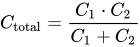
Superkondensatoren haben entweder symmetrische oder asymmetrische Elektroden. Symmetrie bedeutet, dass beide Elektroden den gleichen Kapazitätswert haben, was eine Gesamtkapazität von der Hälfte des Werts jeder einzelnen Elektrode ergibt (wenn C 1 = C 2 dann C gesamt = 1/2 C 1 ). Für asymmetrische Kondensatoren kann die Gesamtkapazität als diejenige der Elektrode mit der kleineren Kapazität angesehen werden (wenn C 1 >> C 2 dann
Speicherprinzipien [ edit ]
Elektrochemische Kondensatoren nutzen den Doppelschichteffekt zum Speichern elektrischer Energie; Diese Doppelschicht hat jedoch kein herkömmliches festes Dielektrikum, um die Ladungen zu trennen. In der elektrischen Doppelschicht der Elektroden gibt es zwei Speicherprinzipien, die zur Gesamtkapazität eines elektrochemischen Kondensators beitragen: [21]
Beide Kapazitäten sind nur durch Messtechniken trennbar. Die pro Einheitsspannung in einem elektrochemischen Kondensator gespeicherte Ladungsmenge ist in erster Linie eine Funktion der Elektrodengröße, obwohl die Kapazitätsgröße jedes Speicherprinzips extrem variieren kann.
In der Praxis ergeben diese Speicherprinzipien einen Kondensator mit einem Kapazitätswert von in der Größenordnung von 1 bis 100 Farad. [ erforderliche Zitierung ]
Elektrostatische Doppelschichtkapazität edit ]

Jeder elektrochemische Kondensator hat zwei durch einen Separator mechanisch getrennte Elektroden, die über den Elektrolyten ionisch miteinander verbunden sind. Der Elektrolyt ist eine Mischung aus positiven und negativen Ionen, die in einem Lösungsmittel wie Wasser gelöst sind. An jeder der beiden Elektrodenflächen entsteht ein Bereich, in dem der flüssige Elektrolyt die leitende metallische Oberfläche der Elektrode berührt. Diese Grenzfläche bildet eine gemeinsame Grenze zwischen zwei verschiedenen Materialphasen, beispielsweise einer unlöslichen festen Elektrodenoberfläche und einem benachbarten flüssigen Elektrolyten. In dieser Grenzfläche tritt ein ganz besonderes Phänomen des Doppelschichteffekts auf: [23]
Das Anlegen einer Spannung an einen elektrochemischen Kondensator bewirkt, dass beide Elektroden im Kondensator elektrische Doppelschichten erzeugen. Diese Doppelschichten bestehen aus zwei Ladungsschichten: Eine elektronische Schicht befindet sich in der Oberflächengitterstruktur der Elektrode, und die andere mit entgegengesetzter Polarität tritt aus gelösten und solvatisierten Ionen im Elektrolyten aus. Die beiden Schichten sind durch eine Monolage aus Lösungsmittelmolekülen getrennt, z. G. für Wasser als Lösungsmittel durch Wassermoleküle, genannt innere Helmholtz-Ebene (IHP). Lösungsmittelmoleküle haften durch physikalische Adsorption an der Oberfläche der Elektrode und trennen die entgegengesetzt polarisierten Ionen voneinander und können als molekulares Dielektrikum idealisiert werden. Während des Prozesses findet keine Ladungstransfer zwischen Elektrode und Elektrolyt statt, so dass die Kräfte, die die Adhäsion bewirken, keine chemischen Bindungen sind, sondern physikalische Kräfte (z. B. elektrostatische Kräfte). Die adsorbierten Moleküle sind polarisiert, aber aufgrund der fehlenden Ladungstransfer zwischen Elektrolyt und Elektrode haben sich keine chemischen Veränderungen ergeben.
Die Ladungsmenge in der Elektrode wird durch die Größe der Gegenladungen in der äußeren Helmholtz-Ebene (OHP) bestimmt. Dieses Doppelschichtphänomen speichert elektrische Ladungen wie bei einem herkömmlichen Kondensator. Die Doppelschichtladung bildet ein statisches elektrisches Feld in der Molekülschicht der Lösungsmittelmoleküle im IHP, das der Stärke der angelegten Spannung entspricht.

Die Doppelschicht dient in etwa als dielektrische Schicht in einem herkömmlichen Kondensator mit der Dicke eines einzelnen Moleküls. Somit kann die Standardformel für herkömmliche Plattenkondensatoren verwendet werden, um ihre Kapazität zu berechnen: [24]
- .

.
Entsprechend ist die Kapazität C am größten in Kondensatoren aus Materialien mit hoher Permittivität ε großen Elektrodenplattenoberflächen A und geringem Abstand zwischen den Platten d . Infolgedessen haben Doppelschichtkondensatoren viel höhere Kapazitätswerte als herkömmliche Kondensatoren, was auf die extrem große Oberfläche der Aktivkohleelektroden und den extrem dünnen Doppelschichtabstand in der Größenordnung von wenigen Angström (0,3 bis 0,8 nm) zurückzuführen ist. von Debye-Länge [14] [22]
Der Hauptnachteil von Kohlenstoffelektroden von Doppelschicht-SCs sind kleine Werte der Quantenkapazität [25] die in Serie wirken [26] mit Kapazität der ionischen Raumladung. Daher kann eine weitere Erhöhung der Kapazitätsdichte in SCs mit einer Erhöhung der Quantenkapazität von Kohlenstoffelektroden-Nanostrukturen verbunden werden. [25]
Die pro Spannungseinheit in einem elektrochemischen Kondensator gespeicherte Ladungsmenge ist in erster Linie eine Funktion der Elektrodengröße. Die elektrostatische Energiespeicherung in den Doppelschichten ist bezüglich der gespeicherten Ladung linear und entspricht der Konzentration der adsorbierten Ionen. Während Ladung in herkömmlichen Kondensatoren über Elektronen übertragen wird, hängt die Kapazität in Doppelschichtkondensatoren auch von der begrenzten Bewegungsgeschwindigkeit von Ionen im Elektrolyten und der widerstandsfähigen porösen Struktur der Elektroden ab. Da innerhalb der Elektrode oder des Elektrolyten keine chemischen Veränderungen stattfinden, ist das Laden und Entladen elektrischer Doppelschichten prinzipiell unbegrenzt. Die Lebensdauer von Superkondensatoren ist nur durch Elektrolytverdampfungseffekte begrenzt.
Elektrochemische Pseudokapazität [ edit ]

Durch Anlegen einer Spannung an den Anschlüssen des elektrochemischen Kondensators werden Elektrolytionen zur gegenüberliegenden polarisierten Elektrode bewegt und bilden eine Doppelschicht, in der eine einzelne Schicht aus Lösungsmittelmolekülen als Separator wirkt. Eine Pseudokapazität kann entstehen, wenn spezifisch aus dem Elektrolyten adsorbierte Ionen die Doppelschicht durchdringen. Diese Pseudokapazität speichert elektrische Energie durch reversible faradaysche Redoxreaktionen auf der Oberfläche geeigneter Elektroden in einem elektrochemischen Kondensator mit einer elektrischen Doppelschicht. [11] [21] [22] [28] Die Pseudokapazität geht mit einem Elektronenladungsaustausch zwischen Elektrolyt und Elektrode einher, der von einem desolvatisierten und adsorbierten Ion stammt, wobei nur ein Elektron pro Ladungseinheit beteiligt ist. Dieser faradaysche Ladungstransfer entsteht durch eine sehr schnelle Abfolge von reversiblen Redox-, Interkalations- oder Elektrosorptionsprozessen. Das adsorbierte Ion reagiert mit den Atomen der Elektrode nicht chemisch (es treten keine chemischen Bindungen auf [29] ), da nur ein Ladungstransfer stattfindet.

Die an den faradayischen Prozessen beteiligten Elektronen werden zu oder von Valenzelektronenzuständen (Orbitalen) des Redox-Elektrodenreagens übertragen. Sie treten in die negative Elektrode ein und fließen durch die externe Schaltung zur positiven Elektrode, wo sich eine zweite Doppelschicht mit einer gleichen Anzahl von Anionen gebildet hat. Die Elektronen, die die positive Elektrode erreichen, werden nicht auf die Anionen übertragen, die die Doppelschicht bilden, sondern verbleiben in den stark ionisierten und "elektronenhungrigen" Übergangsmetallionen der Elektrodenoberfläche. Daher ist die Speicherkapazität der faradayischen Pseudokapazität durch die endliche Menge an Reagenz in der verfügbaren Oberfläche begrenzt.
Eine faradaysche Pseudokapazität tritt nur zusammen mit einer statischen Doppelschichtkapazität auf, und ihre Größe kann je nach Art und Struktur der Elektrode den Wert der Doppelschichtkapazität für die gleiche Oberfläche um den Faktor 100 übersteigen Die Pseudokapazitätsreaktionen finden nur mit de-solvatisierten Ionen statt, die viel kleiner sind als solvatisierte Ionen mit ihrer solvatisierenden Hülle. [11] [27] Die Menge der Pseudokapazität hat eine lineare Funktion innerhalb enger Grenzen, die durch den potentiell abhängigen Grad der Oberflächenbedeckung der adsorbierten Anionen bestimmt wird.
Die Fähigkeit von Elektroden, Pseudokapazitätseffekte durch Redoxreaktionen, Interkalation oder Elektrosorption zu erreichen, hängt stark von der chemischen Affinität von Elektrodenmaterialien zu den an der Elektrodenoberfläche adsorbierten Ionen sowie von der Struktur und den Abmessungen der Elektrodenporen ab. Materialien, die ein Redox-Verhalten zur Verwendung als Elektroden in Pseudokondensatoren zeigen, sind Übergangsmetalloxide wie RuO 2 IrO 2 oder MnO 2 die durch Dotierung in die leitfähige Elektrode eingebracht wurden Material wie Aktivkohle sowie leitfähige Polymere wie Polyanilin oder Derivate von Polythiophen, die das Elektrodenmaterial bedecken.
Die Menge an elektrischer Ladung, die in einer Pseudokapazität gespeichert ist, ist linear proportional zu der angelegten Spannung. Die Einheit der Pseudokapazität ist Farad.
Potentialverteilung [ edit ]


Herkömmliche Kondensatoren (auch als elektrostatische Kondensatoren bezeichnet), wie Keramikkondensatoren und Filmkondensatoren, bestehen aus zwei Elektroden getrennt durch ein dielektrisches Material. Beim Laden wird die Energie in einem statischen elektrischen Feld gespeichert, das das Dielektrikum zwischen den Elektroden durchdringt. Die Gesamtenergie steigt mit der Menge der gespeicherten Ladung, die wiederum linear mit dem Potential (Spannung) zwischen den Platten korreliert. Die maximale Potentialdifferenz zwischen den Platten (die maximale Spannung) ist durch die Durchbruchfeldstärke des Dielektrikums begrenzt. Die gleiche statische Speicherung gilt auch für Elektrolytkondensatoren, bei denen der größte Teil des Potentials über der dünnen Oxidschicht der Anode abnimmt. Der etwas widerstandsbehaftete Flüssigelektrolyt (Kathode) bewirkt eine geringe Abnahme des Potentials für "nasse" Elektrolytkondensatoren, während bei Elektrolytkondensatoren mit festem leitfähigem Polymerelektrolyt dieser Spannungsabfall vernachlässigbar ist.
Elektrochemische Kondensatoren (Superkondensatoren) bestehen dagegen aus zwei Elektroden, die durch eine ionenpermeable Membran (Separator) getrennt und über einen Elektrolyten elektrisch verbunden sind. Die Energiespeicherung erfolgt in den Doppelschichten beider Elektroden als Mischung aus Doppelschichtkapazität und Pseudokapazität. Wenn beide Elektroden ungefähr den gleichen Widerstand (Innenwiderstand) haben, nimmt das Potential des Kondensators symmetrisch über beide Doppelschichten ab, wodurch ein Spannungsabfall über den äquivalenten Serienwiderstand (ESR) des Elektrolyts erreicht wird. Bei asymmetrischen Superkondensatoren wie Hybridkondensatoren könnte der Spannungsabfall zwischen den Elektroden asymmetrisch sein. Das maximale Potential am Kondensator (die maximale Spannung) wird durch die Elektrolytzerlegungsspannung begrenzt.
Sowohl die elektrostatische als auch die elektrochemische Energiespeicherung in Superkondensatoren ist wie in konventionellen Kondensatoren linear bezüglich der gespeicherten Ladung. Die Spannung zwischen den Kondensatoranschlüssen ist in Bezug auf die Menge der gespeicherten Energie linear. Ein solcher linearer Spannungsgradient unterscheidet sich von wiederaufladbaren elektrochemischen Batterien, bei denen die Spannung zwischen den Anschlüssen unabhängig von der Menge an gespeicherter Energie bleibt und eine relativ konstante Spannung liefert.
Vergleich mit anderen Speichertechnologien [ edit ]
Superkondensatoren konkurrieren mit Elektrolytkondensatoren und wiederaufladbaren Batterien, insbesondere mit Lithium-Ionen-Batterien. In der folgenden Tabelle werden die Hauptparameter der drei Hauptkondensatorfamilien mit Elektrolytkondensatoren und Batterien verglichen.
| Parameter | Aluminium elektrolytische Kondensatoren | - Superkondensatoren - | Lithium-Ionen-Batterien | ||
|---|---|---|---|---|---|
| Doppelschichtkondensatoren (Speichersicherung) | Superkondensatoren (hohe Leistung) | Pseudokondensatoren und Hybrid (Li-Ion) (langfristig) | |||
| Temperaturbereich, Celsius (° C) | −40 ... + 125 ° C | −40 ... + 70 ° C | −20 ... + 70 ° C | −20 ... + 70 ° C | −20 ... + 60 ° C |
| Maximale Ladung, Volt (V) | 4 ... 630 V | 1.2 ... 3,3 V | 2.2 ... 3,3 V | 2.2 ... 3,8 V | 2.5 ... 4,2 V |
| Wiederaufladezyklen, Tausende (k) | unbegrenzt | 100 k ... 1 000 k | 100 k ... 1 000 k | 20 k ... 100 k | 0,5 k ... 10 k |
| Kapazität, Farads (F) | ≤ 2,7 F | 0,1 ... 470 F | 100 ... 12 000 F | 300 ... 3 300 F | - |
| Spezifische Energie, Milliwattstunden pro Gramm (mW · h / g) | 0.01 ... 0,3 mW · h / g | 1.5 ... 3,9 mW · h / g | 4 ... 9 mW · h / g | 10 ... 15 mW · h / g | 100 ... 265 mW · h / g |
| Spezifische Leistung, Watt pro Gramm (W / g) | > 100 W / g | 2 ... 10 W / g | 3 ... 10 W / g | 3 ... 14 W / g | 0.3 ... 1,5 W / g |
| Zeit der Selbstentladung bei Raumtemperatur. | kurz (Tage) | mittel (Wochen) | mittel (Wochen) | lang (Monat) | lang (Monat) |
| Effizienz (%) | 99% | 95% | 95% | 90% | 90% |
| Arbeitsleben im Raum Temp., In Jahren (y) | > 20 Jahre | 5 ... 10 Jahre | 5 ... 10 Jahre | 5 ... 10 Jahre | 3 ... 5 y |
Elektrolytkondensatoren zeichnen sich durch unbegrenzte Lade- / Entladezyklen, eine hohe Durchschlagfestigkeit (bis zu 550 V) und einen guten Frequenzgang als AC-Widerstand im unteren Frequenzbereich aus. Superkondensatoren können 10 bis 100 mal mehr Energie als Elektrolytkondensatoren speichern, unterstützen jedoch keine AC-Anwendungen.
In Bezug auf wiederaufladbare Batterien weisen Superkondensatoren höhere Spitzenströme, niedrige Kosten pro Zyklus, keine Gefahr des Überladens, gute Reversibilität, nicht korrodierenden Elektrolyten und geringe Materialtoxizität auf, während Batterien niedrigere Anschaffungskosten, stabile Entladungsspannung bieten Sie erfordern komplexe elektronische Steuerungs- und Schaltgeräte, was zu einem kurzzeitigen Energieverlust und Funkenrisiko führt.
Superkondensatoren werden in verschiedenen Ausführungen hergestellt, z. B. flach mit einem einzelnen Elektrodenpaar, gewickelt in einem zylindrischen Gehäuse oder in einem rechteckigen Gehäuse gestapelt. Da sie einen breiten Bereich von Kapazitätswerten abdecken, kann die Größe der Fälle variieren.
- Verschiedene Arten von Superkondensatoren
Flacher Stil eines Superkondensators für mobile Komponenten
Radialbauweise eines Superkondensators für Leiterplattenmontage für industrielle Anwendungen


Konstruktionsdetails [ edit ]
- Konstruktionsdetails von gewickelten und gestapelten Superkondensatoren mit Aktivkohleelektroden
Schematischer Aufbau eines gewickelten Superkondensators
1. Klemmen, 2. Sicherheitsventil, 3. Dichtscheibe, 4. Aluminiumdose, 5. Pluspol, 6. Separator, 7. Kohleelektrode, 8. Kollektor, 9. Kohleelektrode, 10. Minuspol
Schematischer Aufbau eines Superkondensators mit gestapelten Elektroden
1. positive Elektrode, 2. negative Elektrode, 3. Separator


Superkondensatoren bestehen aus zwei Metallfolien (Stromkollektoren), die jeweils mit einem Elektrodenmaterial wie Aktivkohle beschichtet sind, die als Stromverbindung zwischen dem Elektrodenmaterial und den äußeren Anschlüssen des Kondensators dienen. Speziell zum Elektrodenmaterial ist eine sehr große Oberfläche. In diesem Beispiel wird die Aktivkohle elektrochemisch geätzt, so dass die Oberfläche des Materials um einen Faktor 100.000 größer ist als die glatte Oberfläche. Die Elektroden werden durch eine ionenpermeable Membran (Separator) getrennt gehalten, die als Isolator zum Schutz der Elektroden vor Kurzschlüssen dient. Diese Konstruktion wird anschließend zu einer zylindrischen oder rechteckigen Form gerollt oder gefaltet und kann in einer Aluminiumdose oder einem anpassbaren rechteckigen Gehäuse gestapelt werden. Dann wird die Zelle mit einem flüssigen oder viskosen Elektrolyten organischen oder wässrigen Typs imprägniert. Der Elektrolyt, ein Ionenleiter, dringt in die Poren der Elektroden ein und dient als leitende Verbindung zwischen den Elektroden über den Separator. Schließlich ist das Gehäuse hermetisch abgedichtet, um ein stabiles Verhalten über die angegebene Lebensdauer sicherzustellen.
Superkondensator-Typen [ edit ]

Elektrische Energie wird in Superkondensatoren über zwei Speicherprinzipien gespeichert: statische Doppelschichtkapazität und elektrochemische Pseudokapazität. und die Verteilung der zwei Arten von Kapazität hängt von dem Material und der Struktur der Elektroden ab. Es gibt drei Arten von Superkondensatoren, die auf dem Speicherprinzip basieren: [14] [22]
- Doppelschichtkondensatoren ( EDLCs ) - mit Aktivkohleelektroden oder Derivaten mit viel höhere elektrostatische Doppelschichtkapazität als die elektrochemische Pseudokapazität
- Pseudokondensatoren - mit Übergangsmetalloxid oder leitenden Polymerelektroden mit hoher elektrochemischer Pseudokapazität
- Hybridkondensatoren - mit asymmetrischen Elektroden, von denen eine meist elektrostatisch ist und die andere, meist elektrochemische Kapazität, wie Lithium-Ionen-Kondensatoren
Da Doppelschichtkapazität und Pseudokapazität beide untrennbar zum Gesamtkapazitätswert eines elektrochemischen Kondensators beitragen, kann eine korrekte Beschreibung dieser Kondensatoren nur unter dem Oberbegriff gegeben werden . Die Konzepte der Superkapazität und der Superkabelung wurden kürzlich vorgeschlagen, um Hybridgeräte besser darzustellen, die sich mehr wie Superkondensator bzw. Akku verhalten. [30]
Der Kapazitätswert eines Superkondensators wird durch bestimmt zwei Speicherprinzipien:
Doppelschichtkapazität und Pseudokapazität tragen beide untrennbar zum Gesamtkapazitätswert eines Superkondensators bei. [21] Das Verhältnis der beiden kann jedoch abhängig von der Gestaltung der Elektroden und der Zusammensetzung des Elektrolyts stark variieren. Eine Pseudokapazität kann den Kapazitätswert um den Faktor zehn gegenüber dem der Doppelschicht allein erhöhen. [11] [27]
Elektrische Doppelschichtkondensatoren (EDLC) sind elektrochemische Kondensatoren, in denen Energie vorhanden ist Die Speicherung wird überwiegend durch Doppelschichtkapazität erreicht. In the past, all electrochemical capacitors were called "double-layer capacitors". Contemporary usage sees double-layer capacitors, together with pseudocapacitors, as part of a larger family of electrochemical capacitors[11][27] called supercapacitors. They are also known as ultracapacitors.
Materials[edit]
The properties of supercapacitors come from the interaction of their internal materials. Especially, the combination of electrode material and type of electrolyte determine the functionality and thermal and electrical characteristics of the capacitors.
Electrodes[edit]

Supercapacitor electrodes are generally thin coatings applied and electrically connected to a conductive, metallic current collector. Electrodes must have good conductivity, high temperature stability, long-term chemical stability (inertness), high corrosion resistance and high surface areas per unit volume and mass. Other requirements include environmental friendliness and low cost.
The amount of double-layer as well as pseudocapacitance stored per unit voltage in a supercapacitor is predominantly a function of the electrode surface area. Therefore, supercapacitor electrodes are typically made of porous, spongy material with an extraordinarily high specific surface area, such as activated carbon. Additionally, the ability of the electrode material to perform faradaic charge transfers enhances the total capacitance.
Generally the smaller the electrode's pores, the greater the capacitance and specific energy. However, smaller pores increase equivalent series resistance (ESR) and decrease specific power. Applications with high peak currents require larger pores and low internal losses, while applications requiring high specific energy need small pores.
Electrodes for EDLCs[edit]
The most commonly used electrode material for supercapacitors is carbon in various manifestations such as activated carbon (AC), carbon fibre-cloth (AFC), carbide-derived carbon (CDC), carbon aerogel, graphite (graphene), graphane[31] and carbon nanotubes (CNTs).[21][32][33]
Carbon-based electrodes exhibit predominantly static double-layer capacitance, even though a small amount of pseudocapacitance may also be present depending on the pore size distribution. Pore sizes in carbons typically range from micropores (less than 2 nm) to mesopores (2-50 nm),[34] but only micropores (<2 nm) contribute to pseudocapacitance. As pore size approaches the solvation shell size, solvent molecules are excluded and only unsolvated ions fill the pores (even for large ions), increasing ionic packing density and storage capability by faradaic H
2 intercalation.[21]
Activated carbon[edit]
Activated carbon (AC) was the first material chosen for EDLC electrodes. Even though its electrical conductivity is approximately 0.003% that of metals (1,250 to 2,000 S/m), it is sufficient for supercapacitors.[22][14]
Activated carbon is an extremely porous form of carbon with a high specific surface area — a common approximation is that 1 gram (0.035 oz) (a pencil-eraser-sized amount) has a surface area of roughly 1,000 to 3,000 square metres (11,000 to 32,000 sq ft)[32][34] — about the size of 4 to 12 tennis courts. The bulk form used in electrodes is low-density with many pores, giving high double-layer capacitance.
Solid activated carbon, also termed consolidated amorphous carbon (CAC) is the most used electrode material for supercapacitors and may be cheaper than other carbon derivatives.[35] It is produced from activated carbon powder pressed into the desired shape, forming a block with a wide distribution of pore sizes. An electrode with a surface area of about 1000 m2/g results in a typical double-layer capacitance of about 10 μF/cm2 and a specific capacitance of 100 F/g.
As of 2010[update] virtually all commercial supercapacitors use powdered activated carbon made from coconut shells.[36] Coconut shells produce activated carbon with more micropores than does charcoal made from wood.[34]
Activated carbon fibres[edit]
Activated carbon fibres (ACF) are produced from activated carbon and have a typical diameter of 10 µm. They can have micropores with a very narrow pore-size distribution that can be readily controlled. The surface area of ACF woven into a textile is about 2500 m2/g. Advantages of ACF electrodes include low electrical resistance along the fibre axis and good contact to the collector.[32]
As for activated carbon, ACF electrodes exhibit predominantly double-layer capacitance with a small amount of pseudocapacitance due to their micropores.
Carbon aerogel[edit]

Carbon aerogel is a highly porous, synthetic, ultralight material derived from an organic gel in which the liquid component of the gel has been replaced with a gas.
Aerogel electrodes are made via pyrolysis of resorcinol-formaldehyde aerogels[37] and are more conductive than most activated carbons. They enable thin and mechanically stable electrodes with a thickness in the range of several hundred micrometres (µm) and with uniform pore size. Aerogel electrodes also provide mechanical and vibration stability for supercapacitors used in high-vibration environments.
Researchers have created a carbon aerogel electrode with gravimetric densities of about 400–1200 m2/g and volumetric capacitance of 104 F/cm3yielding a specific energy of 325 kJ/kg (90 Wh/kg) and specific power of 20 W/g.[38][39]
Standard aerogel electrodes exhibit predominantly double-layer capacitance. Aerogel electrodes that incorporate composite material can add a high amount of pseudocapacitance.[40]
Carbide-derived carbon[edit]

Carbide-derived carbon (CDC), also known as tunable nanoporous carbon, is a family of carbon materials derived from carbide precursors, such as binary silicon carbide and titanium carbide, that are transformed into pure carbon via physical (e.g., thermal decomposition) or chemical (e.g., halogenation) processes.[41][42]
Carbide-derived carbons can exhibit high surface area and tunable pore diameters (from micropores to mesopores) to maximize ion confinement, increasing pseudocapacitance by faradaic H
2 adsorption treatment. CDC electrodes with tailored pore design offer as much as 75% greater specific energy than conventional activated carbons.
As of 2015[update]a CDC supercapacitor offered a specific energy of 10.1 Wh/kg, 3,500 F capacitance and over one million charge-discharge cycles.[43]
Graphene[edit]

Graphene is a one-atom thick sheet of graphite, with atoms arranged in a regular hexagonal pattern,[44][45] also called "nanocomposite paper".[46]
Graphene has a theoretical specific surface area of 2630 m2/g which can theoretically lead to a capacitance of 550 F/g. In addition, an advantage of graphene over activated carbon is its higher electrical conductivity. As of 2012[update] a new development used graphene sheets directly as electrodes without collectors for portable applications.[47][48]
In one embodiment, a graphene-based supercapacitor uses curved graphene sheets that do not stack face-to-face, forming mesopores that are accessible to and wettable by ionic electrolytes at voltages up to 4 V. A specific energy of 85.6 Wh/kg (308 kJ/kg) is obtained at room temperature equaling that of a conventional nickel metal hydride battery, but with 100-1000 times greater specific power.[49][50]
The two-dimensional structure of graphene improves charging and discharging. Charge carriers in vertically oriented sheets can quickly migrate into or out of the deeper structures of the electrode, thus increasing currents. Such capacitors may be suitable for 100/120 Hz filter applications, which are unreachable for supercapacitors using other carbon materials.[51]
Carbon nanotubes[edit]


Carbon nanotubes (CNTs), also called buckytubes, are carbon molecules with a cylindrical nanostructure. They have a hollow structure with walls formed by one-atom-thick sheets of graphite. These sheets are rolled at specific and discrete ("chiral") angles, and the combination of chiral angle and radius controls properties such as electrical conductivity, electrolyte wettability and ion access. Nanotubes are categorized as single-walled nanotubes (SWNTs) or multi-walled nanotubes (MWNTs). The latter have one or more outer tubes successively enveloping a SWNT, much like the Russian matryoshka dolls. SWNTs have diameters ranging between 1 and 3 nm. MWNTs have thicker coaxial walls, separated by spacing (0.34 nm) that is close to graphene's interlayer distance.
Nanotubes can grow vertically on the collector substrate, such as a silicon wafer. Typical lengths are 20 to 100 µm.[52]
Carbon nanotubes can greatly improve capacitor performance, due to the highly wettable surface area and high conductivity.[53][54]
A SWNT-based supercapacitor with aqueous electrolyte was systematically studied at University of Delaware in Prof. Bingqing Wei's group. Li et al., for the first time, discovered that the ion-size effect and the electrode-electrolyte wettability are the dominant factors affecting the electrochemical behavior of flexible SWCNTs-supercapacitors in different 1 molar aqueous electrolytes with different anions and cations. The experimental results also showed for flexible supercapacitor that it is suggested to put enough pressure between the two electrodes to improve the aqueous electrolyte CNT supercapacitor.[55]
CNTs can store about the same charge as activated carbon per unit surface area, but nanotubes' surface is arranged in a regular pattern, providing greater wettability. SWNTs have a high theoretical specific surface area of 1315 m2/g, while that for MWNTs is lower and is determined by the diameter of the tubes and degree of nesting, compared with a surface area of about 3000 m2/g of activated carbons. Nevertheless, CNTs have higher capacitance than activated carbon electrodes, e.g., 102 F/g for MWNTs and 180 F/g for SWNTs.[56]
MWNTs have mesopores that allow for easy access of ions at the electrode–electrolyte interface. As the pore size approaches the size of the ion solvation shell, the solvent molecules are partially stripped, resulting in larger ionic packing density and increased faradaic storage capability. However, the considerable volume change during repeated intercalation and depletion decreases their mechanical stability. To this end, research to increase surface area, mechanical strength, electrical conductivity and chemical stability is ongoing.[53][58]
Electrodes for pseudocapacitors[edit]
MnO2 and RuO2 are typical materials used as electrodes for pseudocapacitors, since they have the electrochemical signature of a capacitive electrode (linear dependence on current versus voltage curve) as well as exhibiting faradaic behavior. Additionally, the charge storage originates from electron-transfer mechanisms rather than accumulation of ions in the electrochemical double layer. Pseudocapacitors were created through faradaic redox reactions that occur within the active electrode materials. More research was focused on transition-metal oxides such as MnO2 since transition-metal oxides have a lower cost compared to noble metal oxides such as RuO2. Moreover, the charge storage mechanisms of transition-metal oxides are based predominantly on pseudocapacitance. Two mechanisms of MnO2 charge storage behavior were introduced. The first mechanism implies the intercalation of protons (H+) or alkali metal cations (C+) in the bulk of the material upon reduction followed by deintercalation upon oxidation.[59]
- MnO2 + H+(C+) +e− ⇌ MnOOH(C)[60]
The second mechanism is based on the surface adsorption of electrolyte cations on MnO2.
- (MnO2)surface + C+ +e− ⇌ (MnO2− C+)surface
Not every material that exhibits faradaic behavior can be used as an electrode for pseudocapacitors, such as Ni(OH)2 since it is a battery type electrode (non-linear dependence on current versus voltage curve).[61]
Metal oxides[edit]
Brian Evans Conway's research[11][12] described electrodes of transition metal oxides that exhibited high amounts of pseudocapacitance. Oxides of transition metals including ruthenium (RuO
2), iridium (IrO
2), iron (Fe
3O
4), manganese (MnO
2) or sulfides such as titanium sulfide (TiS
2) alone or in combination generate strong faradaic electron–transferring reactions combined with low resistance.[62] Ruthenium dioxide in combination with H
2SO
4 electrolyte provides specific capacitance of 720 F/g and a high specific energy of 26.7 Wh/kg (96.12 kJ/kg).[63]
Charge/discharge takes place over a window of about 1.2 V per electrode. This pseudocapacitance of about 720 F/g is roughly 100 times higher than for double-layer capacitance using activated carbon electrodes. These transition metal electrodes offer excellent reversibility, with several hundred-thousand cycles. However, ruthenium is expensive and the 2.4 V voltage window for this capacitor limits their applications to military and space applications.
Das et al. reported highest capacitance value (1715 F/g) for ruthenium oxide based supercapacitor with electrodeposited ruthenium oxide onto porous single wall carbon nanotube film electrode.[64] A high specific capacitance of 1715 F/g has been reported which closely approaches the predicted theoretical maximum RuO
2 capacitance of 2000 F/g.
In 2014 a RuO
2 supercapacitor anchored on a graphene foam electrode delivered specific capacitance of 502.78 F/g and areal capacitance of 1.11 F/cm2) leading to a specific energy of 39.28 Wh/kg and specific power of 128.01 kW/kg over 8,000 cycles with constant performance. The device was a three-dimensional (3D) sub-5 nm hydrous ruthenium-anchored graphene and carbon nanotube (CNT) hybrid foam (RGM) architecture. The graphene foam was conformally covered with hybrid networks of RuO
2 nanoparticles and anchored CNTs.[65][66]
Less expensive oxides of iron, vanadium, nickel and cobalt have been tested in aqueous electrolytes, but none has been investigated as much as manganese dioxide (MnO
2). However, none of these oxides are in commercial use.[67]
Conductive polymers[edit]
Another approach uses electron-conducting polymers as pseudocapacitive material. Although mechanically weak, conductive polymers have high conductivity, resulting in a low ESR and a relatively high capacitance. Such conducting polymers include polyaniline, polythiophene, polypyrrole and polyacetylene. Such electrodes also employ electrochemical doping or dedoping of the polymers with anions and cations. Electrodes made from or coated with conductive polymers have costs comparable to carbon electrodes.
Conducting polymer electrodes generally suffer from limited cycling stability.[68] However, polyacene electrodes provide up to 10,000 cycles, much better than batteries.[69]
Electrodes for hybrid capacitors[edit]
All commercial hybrid supercapacitors are asymmetric. They combine an electrode with high amount of pseudocapacitance with an electrode with a high amount of double-layer capacitance. In such systems the faradaic pseudocapacitance electrode with their higher capacitance provides high specific energy while the non-faradaic EDLC electrode enables high specific power. An advantage of the hybrid-type supercapacitors compared with symmetrical EDLC's is their higher specific capacitance value as well as their higher rated voltage and correspondingly their higher specific energy.[70]
Composite electrodes[edit]
Composite electrodes for hybrid-type supercapacitors are constructed from carbon-based material with incorporated or deposited pseudocapacitive active materials like metal oxides and conducting polymers. As of 2013[update] most research for supercapacitors explores composite electrodes.
CNTs give a backbone for a homogeneous distribution of metal oxide or electrically conducting polymers (ECPs), producing good pseudocapacitance and good double-layer capacitance. These electrodes achieve higher capacitances than either pure carbon or pure metal oxide or polymer-based electrodes. This is attributed to the accessibility of the nanotubes' tangled mat structure, which allows a uniform coating of pseudocapacitive materials and three-dimensional charge distribution. The process to anchor pseudocapacitve materials usually uses a hydrothermal process. However, a recent researcher, Li et al., from the University of Delaware found a facile and scalable approach to precipitate MnO2 on a SWNT film to make an organic-electrolyte based supercapacitor.[71]
Another way to enhance CNT electrodes is by doping with a pseudocapacitive dopant as in lithium-ion capacitors. In this case the relatively small lithium atoms intercalate between the layers of carbon.[72] The anode is made of lithium-doped carbon, which enables lower negative potential with a cathode made of activated carbon. This results in a larger voltage of 3.8-4 V that prevents electrolyte oxidation. As of 2007 they had achieved capacitance of 550 F/g.[9] and reach a specific energy up to 14 Wh/kg (50.4 kJ/kg).[73]
Battery-type electrodes[edit]
Rechargeable battery electrodes influenced the development of electrodes for new hybrid-type supercapacitor electrodes as for lithium-ion capacitors.[74] Together with a carbon EDLC electrode in an asymmetric construction offers this configuration higher specific energy than typical supercapacitors with higher specific power, longer cycle life and faster charging and recharging times than batteries.
Asymmetric electrodes (pseudo/EDLC)[edit]
Recently some asymmetric hybrid supercapacitors were developed in which the positive electrode were based on a real pseudocapacitive metal oxide electrode (not a composite electrode), and the negative electrode on an EDLC activated carbon electrode.
An advantage of this type of supercapacitors is their higher voltage and correspondingly their higher specific energy (up to 10-20 Wh/kg (36-72 kJ/kg)).[75]
As far as known no commercial offered supercapacitors with such kind of asymmetric electrodes are on the market.
Electrolytes[edit]
Electrolytes consist of a solvent and dissolved chemicals that dissociate into positive cations and negative anions, making the electrolyte electrically conductive. The more ions the electrolyte contains, the better its conductivity. In supercapacitors electrolytes are the electrically conductive connection between the two electrodes. Additionally, in supercapacitors the electrolyte provides the molecules for the separating monolayer in the Helmholtz double-layer and delivers the ions for pseudocapacitance.
The electrolyte determines the capacitor's characteristics: its operating voltage, temperature range, ESR and capacitance. With the same activated carbon electrode an aqueous electrolyte achieves capacitance values of 160 F/g, while an organic electrolyte achieves only 100 F/g.[76]
The electrolyte must be chemically inert and not chemically attack the other materials in the capacitor to ensure long time stable behavior of the capacitor's electrical parameters. The electrolyte's viscosity must be low enough to wet the porous, sponge-like structure of the electrodes. An ideal electrolyte does not exist, forcing a compromise between performance and other requirements.
Aqueous[edit]
Water is a relatively good solvent for inorganic chemicals. Treated with acids such as sulfuric acid (H
2SO
4), alkalis such as potassium hydroxide (KOH), or salts such as quaternary phosphonium salts, sodium perchlorate (NaClO
4), lithium perchlorate (LiClO
4) or lithium hexafluoride arsenate (LiAsF
6), water offers relatively high conductivity values of about 100 to 1000 mS/cm. Aqueous electrolytes have a dissociation voltage of 1.15 V per electrode (2.3 V capacitor voltage) and a relatively low operating temperature range. They are used in supercapacitors with low specific energy and high specific power.
Organic[edit]
Electrolytes with organic solvents such as acetonitrile, propylene carbonate, tetrahydrofuran, diethyl carbonate, γ-butyrolactone and solutions with quaternary ammonium salts or alkyl ammonium salts such as tetraethylammonium tetrafluoroborate (N(Et)
4BF
4[77]) or triethyl (metyl) tetrafluoroborate (NMe(Et)
3BF
4) are more expensive than aqueous electrolytes, but they have a higher dissociation voltage of typically 1.35 V per electrode (2.7 V capacitor voltage), and a higher temperature range. The lower electrical conductivity of organic solvents (10 to 60 mS/cm) leads to a lower specific power, but since the specific energy increases with the square of the voltage, a higher specific energy.
Separators[edit]
Separators have to physically separate the two electrodes to prevent a short circuit by direct contact. It can be very thin (a few hundredths of a millimeter) and must be very porous to the conducting ions to minimize ESR. Furthermore, separators must be chemically inert to protect the electrolyte's stability and conductivity. Inexpensive components use open capacitor papers. More sophisticated designs use nonwoven porous polymeric films like polyacrylonitrile or Kapton, woven glass fibers or porous woven ceramic fibres.[78][79]
Collectors and housing[edit]
Current collectors connect the electrodes to the capacitor's terminals. The collector is either sprayed onto the electrode or is a metal foil. They must be able to distribute peak currents of up to 100 A.
If the housing is made out of a metal (typically aluminum) the collectors should be made from the same material to avoid forming a corrosive galvanic cell.
Electrical parameters[edit]
Capacitance[edit]


Capacitance values for commercial capacitors are specified as "rated capacitance CR". This is the value for which the capacitor has been designed. The value for an actual component must be within the limits given by the specified tolerance. Typical values are in the range of farads (F), three to six orders of magnitude larger than those of electrolytic capacitors.
The capacitance value results from the energy (expressed in Joule) of a loaded capacitor loaded via a DC voltage VDC.

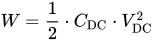
This value is also called the "DC capacitance".
Measurement[edit]
Conventional capacitors are normally measured with a small AC voltage (0.5 V) and a frequency of 100 Hz or 1 kHz depending on the capacitor type. The AC capacitance measurement offers fast results, important for industrial production lines. The capacitance value of a supercapacitor depends strongly on the measurement frequency, which is related to the porous electrode structure and the limited electrolyte's ion mobility. Even at a low frequency of 10 Hz, the measured capacitance value drops from 100 to 20 percent of the DC capacitance value.
This extraordinary strong frequency dependence can be explained by the different distances the ions have to move in the electrode's pores. The area at the beginning of the pores can easily be accessed by the ions. The short distance is accompanied by low electrical resistance. The greater the distance the ions have to cover, the higher the resistance. This phenomenon can be described with a series circuit of cascaded RC (resistor/capacitor) elements with serial RC time constants. These result in delayed current flow, reducing the total electrode surface area that can be covered with ions if polarity changes – capacitance decreases with increasing AC frequency. Thus, the total capacitance is only achieved after longer measuring times.

Out of the reason of the very strong frequency dependence of the capacitance this electrical parameter has to be measured with a special constant current charge and discharge measurement, defined in IEC standards 62391-1 and -2.
Measurement starts with charging the capacitor. The voltage has to be applied and after the constant current/constant voltage power supply has achieved the rated voltage, the capacitor has to be charged for 30 minutes. Next, the capacitor has to be discharged with a constant discharge current Idischarge. Then the time t1 and t2for the voltage to drop from 80% (V1) to 40% (V2) of the rated voltage is measured. The capacitance value is calculated as:

The value of the discharge current is determined by the application. The IEC standard defines four classes:
- Memory backup, discharge current in mA = 1 • C (F)
- Energy storage, discharge current in mA = 0,4 • C (F) • V (V)
- Power, discharge current in mA = 4 • C (F) • V (V)
- Instantaneous power, discharge current in mA = 40 • C (F) • V (V)
The measurement methods employed by individual manufacturers are mainly comparable to the standardized methods.[80][81]
The standardized measuring method is too time consuming for manufacturers to use during production for each individual component. For industrial produced capacitors the capacitance value is instead measured with a faster low frequency AC voltage and a correlation factor is used to compute the rated capacitance.
This frequency dependence affects capacitor operation. Rapid charge and discharge cycles mean that neither the rated capacitance value nor specific energy are available. In this case the rated capacitance value is recalculated for each application condition.
Operating voltage[edit]

Supercapacitors are low voltage components. Safe operation requires that the voltage remain within specified limits. The rated voltage UR is the maximum DC voltage or peak pulse voltage that may be applied continuously and remain within the specified temperature range. Capacitors should never be subjected to voltages continuously in excess of the rated voltage.
The rated voltage includes a safety margin against the electrolyte's breakdown voltage at which the electrolyte decomposes. The breakdown voltage decomposes the separating solvent molecules in the Helmholtz double-layer, f. e. water splits into hydrogen and oxide. The solvent molecules then cannot separate the electrical charges from each other. Higher voltages than rated voltage cause hydrogen gas formation or a short circuit.
Standard supercapacitors with aqueous electrolyte normally are specified with a rated voltage of 2.1 to 2.3 V and capacitors with organic solvents with 2.5 to 2.7 V. Lithium-ion capacitors with doped electrodes may reach a rated voltage of 3.8 to 4 V, but have a lower voltage limit of about 2.2 V.
Operating supercapacitors below the rated voltage improves the long-time behavior of the electrical parameters. Capacitance values and internal resistance during cycling are more stable and lifetime and charge/discharge cycles may be extended.[81]
Higher application voltages require connecting cells in series. Since each component has a slight difference in capacitance value and ESR, it is necessary to actively or passively balance them to stabilize the applied voltage. Passive balancing employs resistors in parallel with the supercapacitors. Active balancing may include electronic voltage management above a threshold that varies the current.
Internal resistance[edit]

Charging/discharging a supercapacitor is connected to the movement of charge carriers (ions) in the electrolyte across the separator to the electrodes and into their porous structure. Losses occur during this movement that can be measured as the internal DC resistance.
With the electrical model of cascaded, series-connected RC (resistor/capacitor) elements in the electrode pores, the internal resistance increases with the increasing penetration depth of the charge carriers into the pores. The internal DC resistance is time dependent and increases during charge/discharge. In applications often only the switch-on and switch-off range is interesting. The internal resistance Ri can be calculated from the voltage drop ΔV2 at the time of discharge, starting with a constant discharge current Idischarge. It is obtained from the intersection of the auxiliary line extended from the straight part and the time base at the time of discharge start (see picture right). Resistance can be calculated by:
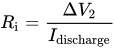
The discharge current Idischarge for the measurement of internal resistance can be taken from the classification according to IEC 62391-1.
This internal DC resistance Ri should not be confused with the internal AC resistance called equivalent series resistance (ESR) normally specified for capacitors. It is measured at 1 kHz. ESR is much smaller than DC resistance. ESR is not relevant for calculating superconductor inrush currents or other peak currents.
Ri determines several supercapacitor properties. It limits the charge and discharge peak currents as well as charge/discharge times. Ri and the capacitance C results in the time constant


This time constant determines the charge/discharge time. A 100 F capacitor with an internal resistance of 30 mΩ for example, has a time constant of 0.03 • 100 = 3 s. After 3 seconds charging with a current limited only by internal resistance, the capacitor has 63.2% of full charge (or is discharged to 36.8% of full charge).
Standard capacitors with constant internal resistance fully charge during about 5 τ. Since internal resistance increases with charge/discharge, actual times cannot be calculated with this formula. Thus, charge/discharge time depends on specific individual construction details.
Current load and cycle stability[edit]
Because supercapacitors operate without forming chemical bonds, current loads, including charge, discharge and peak currents are not limited by reaction constraints. Current load and cycle stability can be much higher than for rechargeable batteries. Current loads are limited only by internal resistance, which may be substantially lower than for batteries.
Internal resistance "Ri" and charge/discharge currents or peak currents "I" generate internal heat losses "Ploss" according to:
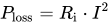
This heat must be released and distributed to the ambient environment to maintain operating temperatures below the specified maximum temperature.
Heat generally defines capacitor lifetime because of electrolyte diffusion. The heat generation coming from current loads should be smaller than 5 to 10 K at maximum ambient temperature (which has only minor influence on expected lifetime). For that reason the specified charge and discharge currents for frequent cycling are determined by internal resistance.
The specified cycle parameters under maximal conditions include charge and discharge current, pulse duration and frequency. They are specified for a defined temperature range and over the full voltage range for a defined lifetime. They can differ enormously depending on the combination of electrode porosity, pore size and electrolyte. Generally a lower current load increases capacitor life and increases the number of cycles. This can be achieved either by a lower voltage range or slower charging and discharging.[81]
Supercapacitors (except those with polymer electrodes) can potentially support more than one million charge/discharge cycles without substantial capacity drops or internal resistance increases. Beneath the higher current load is this the second great advantage of supercapacitors over batteries. The stability results from the dual electrostatic and electrochemical storage principles.
The specified charge and discharge currents can be significantly exceeded by lowering the frequency or by single pulses. Heat generated by a single pulse may be spread over the time until the next pulse occurs to ensure a relatively small average heat increase. Such a "peak power current" for power applications for supercapacitors of more than 1000 F can provide a maximum peak current of about 1000 A.[82] Such high currents generate high thermal stress and high electromagnetic forces that can damage the electrode-collector connection requiring robust design and construction of the capacitors.
Device capacitance and resistance dependence on operating voltage and temperature[edit]

Device parameters such as capacitance initial resistance and steady state resistance are not constant but are variable and dependent on the device's operating voltage. Device capacitance will have a measurable increase as the operating voltage increases. For example: a 100F device can be seen to vary 26% from its maximum capacitance over its entire operational voltage range. Similar dependence on operating voltage is seen in steady state resistance (Rss) and initial resistance (Ri).
[83]
Device properties can also be seen to be dependent on device temperature. As the temperature of the device changes either through operation of varying ambient temperature, the internal properties such as capacitance and resistance will vary as well. Device capacitance is seen to increase as the operating temperature increases.[83]
Energy capacity[edit]

Supercapacitors occupy the gap between high power/low energy electrolytic capacitors and low power/high energy rechargeable batteries. The energy Wmax (expressed in Joule) that can be stored in a capacitor is given by the formula
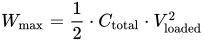
This formula describes the amount of energy stored and is often used to describe new research successes. However, only part of the stored energy is available to applications, because the voltage drop and the time constant over the internal resistance mean that some of the stored charge is inaccessible. The effective realized amount of energy Weff is reduced by the used voltage difference between Vmax and Vmin and can be represented as:[84]

This formula also represents the energy asymmetric voltage components such as lithium ion capacitors.
Specific energy and specific power[edit]
The amount of energy that can be stored in a capacitor per mass of that capacitor is called its specific energy. Specific energy is measured gravimetrically (per unit of mass) in watt-hours per kilogram (Wh/kg).
The amount of energy can be stored in a capacitor per volume of that capacitor is called its energy density. Energy density is measured volumetrically (per unit of volume) in watt-hours per litre (Wh/l).
As of 2013[update] commercial specific energies range from around 0.5 to 15 Wh/kg. For comparison, an aluminum electrolytic capacitor stores typically 0.01 to 0.3 Wh/kgwhile a conventional lead-acid battery stores typically 30 to 40 Wh/kg and modern lithium-ion batteries 100 to 265 Wh/kg. Supercapacitors can therefore store 10 to 100 times more energy than electrolytic capacitors, but only one tenth as much as batteries.[citation needed] For reference, petrol fuel has a specific energy of 44.4 MJ/kg or 12300 Wh/kg (in vehicle propulsion, the efficiency of energy conversions should be considered resulting in 3700 Wh/kg considering a typical 30% internal combustion engine efficiency).
Commercial energy density (also called volumetric specific energy in some literature) varies widely but in general range from around 5 to 8 Wh/l. Units of liters and dm3 can be used interchangeably. In comparison, petrol fuel has an energy density of 32.4 MJ/l or 9000 Wh/l.
Although the specific energy of supercapacitors is insufficient compared with batteries, capacitors have the important advantage of the specific power. Specific power describes the speed at which energy can be delivered to/absorbed from the load. The maximum power is given by the formula:[84]
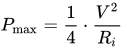
with V = voltage applied and Rithe internal DC resistance of the capacitor.
Specific power is measured either gravimetrically in kilowatts per kilogram (kW/kg, specific power) or volumetrically in kilowatts per litre (kW/l, power density).
The described maximum power Pmax specifies the power of a theoretical rectangular single maximum current peak of a given voltage. In real circuits the current peak is not rectangular and the voltage is smaller, caused by the voltage drop. IEC 62391–2 established a more realistic effective power Peff for supercapacitors for power applications:
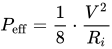
Supercapacitor specific power is typically 10 to 100 times greater than for batteries and can reach values up to 15 kW/kg.
Ragone charts relate energy to power and are a valuable tool for characterizing and visualizing energy storage components. With such a diagram, the position of specific power and specific energy of different storage technologies is easily to compare, see diagram.[85][86]
Lifetime[edit]

Since supercapacitors do not rely on chemical changes in the electrodes (except for those with polymer electrodes), lifetimes depend mostly on the rate of evaporation of the liquid electrolyte. This evaporation in general is a function of temperature, of current load, current cycle frequency and voltage. Current load and cycle frequency generate internal heat, so that the evaporation-determining temperature is the sum of ambient and internal heat. This temperature is measurable as core temperature in the center of a capacitor body. The higher the core temperature the faster the evaporation and the shorter the lifetime.
Evaporation generally results in decreasing capacitance and increasing internal resistance. According to IEC/EN 62391-2 capacitance reductions of over 30% or internal resistance exceeding four times its data sheet specifications are considered "wear-out failures", implying that the component has reached end-of-life. The capacitors are operable, but with reduced capabilities. Whether the aberration of the parameters have any influence on the proper functionality or not depends on the application of the capacitors.
Such large changes of electrical parameters specified in IEC/EN 62391-2 are usually unacceptable for high current load applications. Components that support high current loads use much smaller limits, e.g., 20% loss of capacitance or double the internal resistance.[87] The narrower definition is important for such applications, since heat increases linearly with increasing internal resistance and the maximum temperature should not be exceeded. Temperatures higher than specified can destroy the capacitor.
The real application lifetime of supercapacitors, also called "service life", "life expectancy" or "load life", can reach 10 to 15 years or more at room temperature. Such long periods cannot be tested by manufacturers. Hence, they specify the expected capacitor lifetime at the maximum temperature and voltage conditions. The results are specified in datasheets using the notation "tested time (hours)/max. temperature (°C)", such as "5000 h/65 °C". With this value and expressions derived from historical data, lifetimes can be estimated for lower temperature conditions.
Datasheet lifetime specification is tested by the manufactures using an accelerated aging test called "endurance test" with maximum temperature and voltage over a specified time. For a "zero defect" product policy during this test no wear out or total failure may occur.
The lifetime specification from datasheets can be used to estimate the expected lifetime for a given design. The "10-degrees-rule" used for electrolytic capacitors with non-solid electrolyte is used in those estimations and can be used for supercapacitors. This rule employs the Arrhenius equation, a simple formula for the temperature dependence of reaction rates. For every 10 °C reduction in operating temperature, the estimated life doubles.
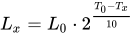
With
- Lx = estimated lifetime
- L0 = specified lifetime
- T0 = upper specified capacitor temperature
- Tx = actual operating temperature of the capacitor cell
Calculated with this formula, capacitors specified with 5000 h at 65 °C, have an estimated lifetime of 20,000 h at 45 °C.
Lifetimes are also dependent on the operating voltage, because the development of gas in the liquid electrolyte depends on the voltage. The lower the voltage the smaller the gas development and the longer the lifetime. No general formula relates voltage to lifetime. The voltage dependent curves shown from the picture are an empirical result from one manufacturer.
Life expectancy for power applications may be also limited by current load or number of cycles. This limitation has to be specified by the relevant manufacturer and is strongly type dependent.
Self-discharge[edit]
Storing electrical energy in the double-layer separates the charge carriers within the pores by distances in the range of molecules. Over this short distance irregularities can occur, leading to a small exchange of charge carriers and gradual discharge. This self-discharge is called leakage current. Leakage depends on capacitance, voltage, temperature and the chemical stability of the electrode/electrolyte combination. At room temperature leakage is so low that it is specified as time to self-discharge. Supercapacitor self-discharge time is specified in hours, days or weeks. As an example, a 5.5 V/F Panasonic "Goldcapacitor" specifies a voltage drop at 20 °C from 5.5 V to 3 V in 600 hours (25 days or 3.6 weeks) for a double cell capacitor.[88]
Post charge voltage relaxation[edit]

It has been noticed that after the EDLC experiences a charge or discharge, the voltage will drift over time, relaxing toward its previous voltage level. The observed relaxation can occur over several hours and is likely due to long diffusion time constants of the porous electrodes within the EDLC.
[83]
Polarity[edit]

Since the positive and negative electrodes (or simply positrode and negatrode, respectively) of symmetric supercapacitors consist of the same material, theoretically supercapacitors have no true polarity and catastrophic failure does not normally occur. However reverse-charging a supercapacitor lowers its capacity, so it is recommended practice to maintain the polarity resulting from the formation of the electrodes during production. Asymmetric supercapacitors are inherently polar.
Pseudocapacitor and hybrid supercapacitors which have electrochemical charge properties may not be operated with reverse polarity, precluding their use in AC operation. However, this limitation does not apply to EDLC supercapacitors
A bar in the insulating sleeve identifies the negative terminal in a polarized component.
In some literature, the terms "anode" and "cathode" are used in place of negative electrode and positive electrode. Using anode and cathode to describe the electrodes in supercapacitors (and also rechargeable batteries including lithium ion batteries) can lead to confusion, because the polarity changes depending on whether a component is considered as a generator or as a consumer of current. In electrochemistry, cathode and anode are related to reduction and oxidation reactions, respectively. However, in supercapacitors based on electric double layer capacitance, there is no oxidation and/or reduction reactions on any of the two electrodes. Therefore, the concepts of cathode and anode do not apply.
Comparison of selected commercial supercapacitors[edit]
The range of electrodes and electrolytes available yields a variety of components suitable for diverse applications. The development of low-ohmic electrolyte systems, in combination with electrodes with high pseudocapacitance, enable many more technical solutions.
The following table shows differences among capacitors of various manufacturers in capacitance range, cell voltage, internal resistance (ESR, DC or AC value) and volumetric and gravimetric specific energy.
In the table, ESR refers to the component with the largest capacitance value of the respective manufacturer. Roughly, they divide supercapacitors into two groups. The first group offers greater ESR values of about 20 milliohms and relatively small capacitance of 0.1 to 470 F. These are "double-layer capacitors" for memory back-up or similar applications. The second group offers 100 to 10,000 F with a significantly lower ESR value under 1 milliohm. These components are suitable for power applications. A correlation of some supercapacitor series of different manufacturers to the various construction features is provided in Pandolfo and Hollenkamp.[32]
| Manufacturer | Series name | Capacitance range (F) | Cell voltage (V) | Volumetric specific energy (Wh/dm3) | Gravimetric specific energy (Wh/kg) | Remarks |
|---|---|---|---|---|---|---|
| APowerCap[89] | APowerCap | 4...550 | 2.7 | – | ≤4.5 | – |
| AVX[90] | BestCap | 0.05...0.56 | 3.6 | ≤0.13 | – | Modules up to 20 V |
| Cap-XX[91] | Cap-XX | 0.17...2.4 | 2.5 | ≤2.2 | - | – |
| CDE[92] | Ultracapacitor | 0.1...1.0 | 3.6 | - | - | – |
| Cooper[93] | PowerStor | 0.22...3000 | 2.5/2.7 | ¬ | – | Modules up to 62 V |
| Elna[94] | DYNACAP POWERCAP | 0.047...1500 | 2.5/3.6 | - | – | – |
| Evans[95] | Capattery | 0.001...10 | 5.5...125 | – | – | Hybrid capacitors |
| FastCAP Systems[96] | EEx | 340-460 | 1-3 | ≤10.5 | – | – |
| Green Tech[97] | Super Capacitor | 2...600 | 2.7/2.8 | - | - | Modules up to 64 V |
| Illinois[98] | Supercapacitor | 0.3800 | 2.3/2.7 | ≤8.6 | ≤6.6 | – |
| Ioxus[99] | Ultracapacitor | 100...3000 | 2.7 | ≤8.7 | ≤6.4 | Modules up to 130 V |
| JSR Micro[100] | Ultimo | 1100...3300 | 3.8 | ≤20 | ≤12 | Li-Ion-capacitors |
| Korchip[101] | STARCAP | 0.02...400 | 2.5/2.7 | ≤7.0 | ≤6.1 | - |
| LS Mtron[102] | Ultracapacitor | 100...3400 | 2.7/2.8 | - | - | Modules up to 130 V |
| Maxwell[103] | Ultracapacitor | 1...3400 | 2.2/2.8 | - | ≤6.0 | Modules up to 160 V |
| Murata[104] | EDLC | 0.22...1.0 | 4.2/5.5 | ≤2.7 | ≤3.1 | 2 cells in series |
| NEC Tokin[105] | Supercapacitor | 0.047...200 | 2.7/11 | – | – | – |
| Nesscap[106] | Ultracapacitor | 3...50 50...300 | 2.7 2.3 | ≤7.1 ≤12.9 | ≤4.5 ≤8.7 | Modules up to 125 V |
| Nichicon[107] | EVerCAP | 1.0...6000 | 2.5/2.7 | - | - | - |
| NCC, ECC[108] | DLCCAP | 350...2300 | 2.5 | - | - | - |
| Panasonic[109] | Goldcap | 0.1...70 | 2.3/2.5 | - | - | Modules up to 15 V |
| Samwha[110] | Green-Cap ESD-SCAP | 3...7500 | 2.5/2.7 | ≤7.6 | ≤7.0 | - |
| Sech SA | C-Capacitor | 330...3200 | 3.0 | <8.0 | Module up to 144V, Storage System up to 12MW | |
| Skeleton[111] | SkelCap | 250...4500 | 2.85 | ≤14.1 | ≤10.1 | Modules up to 350 V |
| SPS[112] | Ultracapacitor | 0.5...5000 | 2.5/2.7 | - | ≤6.5 | Modules up to 500 V |
| Taiyo Yuden[113] | PAS Capacitor LIC Capacitor | 0.5...20 0.5...270 | 2.5/3.0 3.8 | – – | – – | Pseudocapacitors Li-Ion-capacitors |
| VinaTech[114] | Hy-Cap | 1.0...500 | 2.3/3.0 | ≤8.7 | ≤6.3 | – |
| Vishay[115] | ENYCAP | 4...15 | 1.4 | - | - | Modules up to 8.4 V |
| WIMA[116] | SuperCap | 100...3000 | 2.5 | - | - | Modules up to 28 V |
| YEC[117] | Kapton capacitor | 0.5...400 | 2.7 | - | - | – |
| Yunasko[118] | Ultracapacitor | 480...1700 | 2.7 | - | - | Modules up to 48 V |
In commercial double-layer capacitors, or, more specifically, EDLCs in which energy storage is predominantly achieved by double-layer capacitance, energy is stored by forming an electrical double layer of electrolyte ions on the surface of conductive electrodes. Since EDLCs are not limited by the electrochemical charge transfer kinetics of batteries, they can charge and discharge at a much higher rate, with lifetimes of more than 1 million cycles. The EDLC energy density is determined by operating voltage and the specific capacitance (farad/gram or farad/cm3) of the electrode/electrolyte system. The specific capacitance is related to the Specific Surface Area (SSA) accessible by the electrolyte, its interfacial double-layer capacitance, and the electrode material density.
Commercial EDLCs are based on two symmetric electrodes impregnated with electrolytes comprising tetraethylammonium tetrafluoroborate salts in organic solvents. Current EDLCs containing organic electrolytes operate at 2.7 V and reach energy densities around 5-8 Wh/kg and 7 to 10 Wh/l. The specific capacitance is related to the specific surface area (SSA) accessible by the electrolyte, its interfacial double-layer capacitance, and the electrode material density. Graphene-based platelets with mesoporous spacer material is a promising structure for increasing the SSA of the electrolyte.[119]
Standards[edit]

Supercapacitors vary sufficiently that they are rarely interchangeable, especially those with higher specific energy. Applications range from low to high peak currents, requiring standardized test protocols.[120]
Test specifications and parameter requirements are specified in the generic specification
- IEC/EN 62391–1, Fixed electric double layer capacitors for use in electronic equipment.
The standard defines four application classes, according to discharge current levels:
- Memory backup
- Energy storage, mainly used for driving motors require a short time operation,
- Power, higher power demand for a long time operation,
- Instantaneous power, for applications that requires relatively high current units or peak currents ranging up to several hundreds of amperes even with a short operating time
Three further standards describe special applications:
- IEC 62391–2, Fixed electric double-layer capacitors for use in electronic equipment - Blank detail specification - Electric double-layer capacitors for power application
- IEC 62576, Electric double-layer capacitors for use in hybrid electric vehicles. Test methods for electrical characteristics
- BS/EN 61881-3, Railway applications. Rolling stock equipment. Capacitors for power electronics. Electric double-layer capacitors
Applications[edit]
Supercapacitors do not support AC applications.
Supercapacitors have advantages in applications where a large amount of power is needed for a relatively short time, where a very high number of charge/discharge cycles or a longer lifetime is required. Typical applications range from milliamp currents or milliwatts of power for up to a few minutes to several amps current or several hundred kilowatts power for much shorter periods.
The time t a supercapacitor can deliver a constant current I can be calculated as:
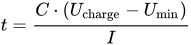
as the capacitor voltage decreases from Ucharge down to Umin.
If the application needs a constant power P for a certain time t this can be calculated as:

wherein also the capacitor voltage decreases from Ucharge down to Umin.
General[edit]
Consumer electronics[edit]
In applications with fluctuating loads, such as laptop computers, PDA's, GPS, portable media players, hand-held devices,[121] and photovoltaic systems, supercapacitors can stabilize the power supply.
Supercapacitors deliver power for photographic flashes in digital cameras and for LED flashlights that can be charged in very short periods of time, e.g., 90 seconds.[122]
Some portable speakers are powered by supercapacitors.[123]
Tools[edit]
A cordless electric screwdriver with supercapacitors for energy storage has about half the run time of a comparable battery model, but can be fully charged in 90 seconds. It retains 85% of its charge after three months left idle.[124]
Grid power buffer[edit]
A group of EVs and HEVs during their charging process draw very high current for a short duration of time which creates power pulsation on the grid.[125] Power pulsation not only reduces the efficiency of the grid and cause voltage drop in the common coupling bus, but it can cause considerable frequency fluctuation in the entire system. To overcome this problem, supercapacitors can be implemented as an interface between the charging station and the grid to buffer the grid from the high pulse power drawn from the charging station.[126][127]
Low-power equipment power buffer[edit]
Supercapacitors provide backup or emergency shutdown power to low-power equipment such as RAM, SRAM, micro-controllers and PC Cards. They are the sole power source for low energy applications such as automated meter reading (AMR)[128] equipment or for event notification in industrial electronics.
Supercapacitors buffer power to and from rechargeable batteries, mitigating the effects of short power interruptions and high current peaks. Batteries kick in only during extended interruptions, e.g., if the mains power or a fuel cell fails, which lengthens battery life.
Uninterruptible power supplies (UPS) may be powered by supercapacitors, which can replace much larger banks of electrolytic capacitors. This combination reduces the cost per cycle, saves on replacement and maintenance costs, enables the battery to be downsized and extends battery life.[129][130][131] A disadvantage is the need for a special circuit to reconcile the differing behaviors.

Supercapacitors provide backup power for actuators in wind turbine pitch systems, so that blade pitch can be adjusted even if the main supply fails.[132]
Voltage stabilizer[edit]
Supercapacitors can stabilize voltage for powerlines. Wind and photovoltaic systems exhibit fluctuating supply evoked by gusting or clouds that supercapacitors can buffer within milliseconds. This helps stabilize grid voltage and frequency, balance supply and demand of power and manage real or reactive power.[133][134][135]
Energy harvesting[edit]
Supercapacitors are suitable temporary energy storage devices for energy harvesting systems. In energy harvesting systems, the energy is collected from the ambient or renewable sources, e.g. mechanical movement, light or electromagnetic fields, and converted to electrical energy in an energy storage device. For example, it was demonstrated that energy collected from RF (radio frequency) fields (using an RF antenna as an appropriate rectifier circuit) can be stored to a printed supercapacitor. The harvested energy was then used to power an application-specific integrated circuit (ASIC) circuit for over 10 hours.[136]
Incorporation into batteries[edit]
The UltraBattery is a hybrid rechargeable lead-acid battery and a supercapacitor invented by Australia's national science organisation CSIRO. Its cell construction contains a standard lead-acid battery positive electrode, standard sulphuric acid electrolyte and a specially prepared negative carbon-based electrode that store electrical energy with double-layer capacitance. The presence of the supercapacitor electrode alters the chemistry of the battery and affords it significant protection from sulfation in high rate partial state of charge use, which is the typical failure mode of valve regulated lead-acid cells used this way. The resulting cell performs with characteristics beyond either a lead-acid cell or a supercapacitor, with charge and discharge rates, cycle life, efficiency and performance all enhanced. UltraBattery has been installed in kW and MW scale applications in Australia, Japan and the U.S.A. in frequency regulation, solar smoothing and shifting, wind smoothing and other applications.[137]
Street lights[edit]

Sado City, in Japan's Niigata Prefecture, has street lights that combine a stand-alone power source with solar cells and LEDs. Supercapacitors store the solar energy and supply 2 LED lamps, providing 15 W power consumption overnight. The supercapacitors can last more than 10 years and offer stable performance under various weather conditions, including temperatures from +40 to below -20 °C.[138]
Medical[edit]
Supercapacitors are used in defibrillators where they can deliver 500 joules to shock the heart back into sinus rhythm.[139]
Transport[edit]
Aviation[edit]
In 2005, aerospace systems and controls company Diehl Luftfahrt Elektronik GmbH chose supercapacitors to power emergency actuators for doors and evacuation slides used in airliners, including the Airbus 380.[132]
Military[edit]
Supercapacitors' low internal resistance supports applications that require short-term high currents. Among the earliest uses were motor startup (cold engine starts, particularly with diesels) for large engines in tanks and submarines.[140] Supercapacitors buffer the battery, handling short current peaks, reducing cycling and extending battery life.
Further military applications that require high specific power are phased array radar antennae, laser power supplies, military radio communications, avionics displays and instrumentation, backup power for airbag deployment and GPS-guided missiles and projectiles.[141][142]
Automotive[edit]
Toyota's Yaris Hybrid-R concept car uses a supercapacitor to provide bursts of power. PSA Peugeot Citroën has started using supercapacitors as part of its stop-start fuel-saving system, which permits faster initial acceleration.[143] Mazda's i-ELOOP system stores energy in a supercapacitor during deceleration and uses it to power on-board electrical systems while the engine is stopped by the stop-start system.
Bus/tram[edit]
Maxwell Technologies, an American supercapacitor-maker, claimed that more than 20,000 hybrid buses use the devices to increase acceleration, particularly in China. Guangzhou, In 2014 China began using trams powered with supercapacitors that are recharged in 30 seconds by a device positioned between the rails, storing power to run the tram for up to 4 km — more than enough to reach the next stop, where the cycle can be repeated.[143]
Energy recovery[edit]
A primary challenge of all transport is reducing energy consumption and reducing CO
2 emissions. Recovery of braking energy (recuperation or regeneration) helps with both. This requires components that can quickly store and release energy over long times with a high cycle rate. Supercapacitors fulfill these requirements and are therefore used in a lot of applications in all kinds of transportation.
Railway[edit]

Supercapacitors can be used to supplement batteries in starter systems in diesel railroad locomotives with diesel-electric transmission. The capacitors capture the braking energy of a full stop and deliver the peak current for starting the diesel engine and acceleration of the train and ensures the stabilization of line voltage. Depending on the driving mode up to 30% energy saving is possible by recovery of braking energy. Low maintenance and environmentally friendly materials encouraged the choice of supercapacitors.[144][145]
Cranes, forklifts and tractors[edit]

Mobile hybrid diesel-electric rubber tyred gantry cranes move and stack containers within a terminal. Lifting the boxes requires large amounts of energy. Some of the energy could be recaptured while lowering the load resulting in improved efficiency.[146]
A triple hybrid forklift truck uses fuel cells and batteries as primary energy storage and supercapacitors to buffer power peaks by storing braking energy. They provide the fork lift with peak power over 30 kW. The triple-hybrid system offers over 50% energy savings compared with diesel or fuel-cell systems.[147]
Supercapacitor-powered terminal tractors transport containers to warehouses. They provide an economical, quiet and pollution-free alternative to diesel terminal tractors.[148]
Light-rails and trams[edit]
Supercapacitors make it possible not only to reduce energy but to replace overhead lines in historical city areas, so preserving the city's architectural heritage. This approach may allow many new LRV city lines to replace overhead wires that are too expensive to fully route.

In 2003 Mannheim adopted a prototype light-rail vehicle (LRV) using the MITRAC Energy Saver system from Bombardier Transportation to store mechanical braking energy with a roof-mounted supercapacitor unit.[149][150] It contains several units each made of 192 capacitors with 2700 F / 2.7 V interconnected in three parallel lines. This circuit results in a 518 V system with an energy content of 1.5 kWh. For acceleration when starting this "on-board-system" can provide the LRV with 600 kW and can drive the vehicle up to 1 km without overhead line supply, thus better integrating the LRV into the urban environment. Compared to conventional LRVs or Metro vehicles that return energy into the grid, onboard energy storage saves up to 30% and reduces peak grid demand by up to 50%.[151]

In 2009 supercapacitors enabled LRV's to operate in the historical city area of Heidelberg without overhead wires, thus preserving the city's architectural heritage.[citation needed] The SC equipment cost an additional €270,000 per vehicle, which was expected to be recovered over the first 15 years of operation. The supercapacitors are charged at stop-over stations when the vehicle is at a scheduled stop. In April 2011 German regional transport operator Rhein-Neckar, responsible for Heidelberg, ordered a further 11 units.[152]
In 2009, Alstom and RATP equipped a Citadis tram with an experimental energy recovery system called "STEEM".[153] The system is fitted with 48 roof-mounted supercapacitors to store braking energy which provides tramways with a high level of energy autonomy by enabling them to run without overhead power lines on parts of its route, recharging while traveling on powered stop-over stations. During the tests, which took place between the Porte d’Italie and Porte de Choisy stops on line T3 of the tramway network in Paris, the tramset used an average of approximately 16% less energy.[154]

In 2012 tram operator Geneva Public Transport began tests of an LRV equipped with a prototype roof-mounted supercapacitor unit to recover braking energy.[155]
Siemens is delivering supercapacitor-enhanced light-rail transport systems that include mobile storage.[156]
Hong Kong's South Island metro line is to be equipped with two 2 MW energy storage units that are expected to reduce energy consumption by 10%.[157]
In August 2012 the CSR Zhuzhou Electric Locomotive corporation of China presented a prototype two-car light metro train equipped with a roof-mounted supercapacitor unit. The train can travel up 2 km without wires, recharging in 30 seconds at stations via a ground mounted pickup. The supplier claimed the trains could be used in 100 small and medium-sized Chinese cities.[158] Seven trams (street cars) powered by supercapacitors were scheduled to go into operation in 2014 in Guangzhou, China. The supercapacitors are recharged in 30 seconds by a device positioned between the rails. That powers the tram for up to 4 kilometres (2.5 mi).[159]
As of 2017, Zhuzhou's supercapacitor vehicles are also used on the new Nanjing streetcar system, and are undergoing trials in Wuhan.[160]
In 2012, in Lyon (France), the SYTRAL (Lyon public transportation administration) started experiments of a "way side regeneration" system built by Adetel Group which has developed its own energy saver named ″NeoGreen″ for LRV, LRT and metros.[161]
In 2015, Alstom announced SRS, an energy storage system that charges supercapacitors on board a tram by means of ground-level conductor rails located at tram stops. This allows trams to operate without overhead lines for short distances.[162] The system has been touted as an alternative to the company's ground-level power supply (APS) system, or can be used in conjunction with it, as in the case of the VLT network in Rio de Janeiro, Brazil, which opened in 2016.[163]
Buses[edit]

The first hybrid bus with supercapacitors in Europe came in 2001 in Nuremberg, Germany. It was MAN's so-called "Ultracapbus", and was tested in real operation in 2001/2002. The test vehicle was equipped with a diesel-electric drive in combination with supercapacitors. The system was supplied with 8 Ultracap modules of 80 V, each containing 36 components. The system worked with 640 V and could be charged/discharged at 400 A. Its energy content was 0.4 kWh with a weight of 400 kg.
The supercapacitors recaptured braking energy and delivered starting energy. Fuel consumption was reduced by 10 to 15% compared to conventional diesel vehicles. Other advantages included reduction of CO
2 emissions, quiet and emissions-free engine starts, lower vibration and reduced maintenance costs.[164][165]

As of 2002[update] in Luzern, Switzerland an electric bus fleet called TOHYCO-Rider was tested. The supercapacitors could be recharged via an inductive contactless high-speed power charger after every transportation cycle, within 3 to 4 minutes.[166]
In early 2005 Shanghai tested a new form of electric bus called capabus that runs without powerlines (catenary free operation) using large onboard supercapacitors that partially recharge whenever the bus is at a stop (under so-called electric umbrellas), and fully charge in the terminus. In 2006, two commercial bus routes began to use the capabuses; one of them is route 11 in Shanghai. It was estimated that the supercapacitor bus was cheaper than a lithium-ion battery bus, and one of its buses had one-tenth the energy cost of a diesel bus with lifetime fuel savings of $200,000.[167]
A hybrid electric bus called tribrid was unveiled in 2008 by the University of Glamorgan, Wales, for use as student transport. It is powered by hydrogen fuel or solar cells, batteries and ultracapacitors.[168][169]
Motor racing[edit]


The FIA, a governing body for motor racing events, proposed in the Power-Train Regulation Framework for Formula 1 version 1.3 of 23 May 2007 that a new set of power train regulations be issued that includes a hybrid drive of up to 200 kW input and output power using "superbatteries" made with batteries and supercapacitors connected in parallel (KERS).[170][171] About 20% tank-to-wheel efficiency could be reached using the KERS system.
The Toyota TS030 Hybrid LMP1 car, a racing car developed under Le Mans Prototype rules, uses a hybrid drivetrain with supercapacitors.[172][173] In the 2012 24 Hours of Le Mans race a TS030 qualified with a fastest lap only 1.055 seconds slower (3:24.842 versus 3:23.787)[174] than the fastest car, an Audi R18 e-tron quattro with flywheel energy storage. The supercapacitor and flywheel components, whose rapid charge-discharge capabilities help in both braking and acceleration, made the Audi and Toyota hybrids the fastest cars in the race. In the 2012 Le Mans race the two competing TS030s, one of which was in the lead for part of the race, both retired for reasons unrelated to the supercapacitors. The TS030 won three of the 8 races in the 2012 FIA World Endurance Championship season. In 2014 the Toyota TS040 Hybrid used a supercapacitor to add 480 horsepower from two electric motors.[159]
Hybrid electric vehicles[edit]

Supercapacitor/battery combinations in electric vehicles (EV) and hybrid electric vehicles (HEV) are well investigated.[120][175][176] A 20 to 60% fuel reduction has been claimed by recovering brake energy in EVs or HEVs. The ability of supercapacitors to charge much faster than batteries, their stable electrical properties, broader temperature range and longer lifetime are suitable, but weight, volume and especially cost mitigate those advantages.
Supercapacitors lower specific energy makes them unsuitable for use as a stand-alone energy source for long distance driving.[177] The fuel economy improvement between a capacitor and a battery solution is about 20% and is available only for shorter trips. For long distance driving the advantage decreases to 6%. Vehicles combining capacitors and batteries run only in experimental vehicles.[178]
As of 2013[update] all automotive manufacturers of EV or HEVs have developed prototypes that uses supercapacitors instead of batteries to store braking energy in order to improve driveline efficiency. The Mazda 6 is the only production car that uses supercapacitors to recover braking energy. Branded as i-eloop, the regenerative braking is claimed to reduce fuel consumption by about 10%.[179]
Russian Yo-cars Ё-mobile series was a concept and crossover hybrid vehicle working with a gasoline driven rotary vane type and an electric generator for driving the traction motors. A supercapacitor with relatively low capacitance recovers brake energy to power the electric motor when accelerating from a stop.[180]
Toyota's Yaris Hybrid-R concept car uses a supercapacitor to provide quick bursts of power.[159]
PSA Peugeot Citroën fit supercapacitors to some of its cars as part of its stop-start fuel-saving system, as this permits faster start-ups when the traffic lights turn green.[159]
Gondolas[edit]

In Zell am See, Austria, an aerial lift connects the city with Schmittenhöhe mountain. The gondolas sometimes run 24 hours per day, using electricity for lights, door opening and communication. The only available time for recharging batteries at the stations is during the brief intervals of guest loading and unloading, which is too short to recharge batteries. Supercapacitors offer a fast charge, higher number of cycles and longer life time than batteries.
Emirates Air Line (cable car), also known as the Thames cable car, is a 1-kilometre (0.62 mi) gondola line that crosses the Thames from the Greenwich Peninsula to the Royal Docks. The cabins are equipped with a modern infotainment system, which is powered by supercapacitors.[181][182]
Developments[edit]
As of 2013[update] commercially available lithium-ion supercapacitors offered the highest gravimetric specific energy to date, reaching 15 Wh/kg (54 kJ/kg). Research focuses on improving specific energy, reducing internal resistance, expanding temperature range, increasing lifetimes and reducing costs.[20]
Projects include tailored-pore-size electrodes, pseudocapacitive coating or doping materials and improved electrolytes.
| Development | Date | Specific energy[A] | Specific power | Cycles | Capacitance | Notes |
|---|---|---|---|---|---|---|
| Graphene sheets compressed by capillary compression of a volatile liquid[183] | 2013 | 60 Wh/L | Subnanometer scale electrolyte integration created a continuous ion transport network. | |||
| Vertically aligned carbon nanotubes electrodes[9][54] | 2007 2009 2013 | 13.50 Wh/kg | 37.12 W/g | 300,000 | First realization[184] | |
| Curved graphene sheets[49][50] | 2010 | 85.6 Wh/kg | 550 F/g | Single-layers of curved graphene sheets that do not restack face-to-face, forming mesopores that are accessible to and wettable by environmentally friendly ionic electrolytes at a voltage up to 4 V. | ||
| KOH restructured graphite oxide[185][186] | 2011 | 85 Wh/kg | >10,000 | 200 F/g | Potassium hydroxide restructured the carbon to make a three dimensional porous network | |
| Activated graphene-based carbons as supercapacitor electrodes with macro- and mesopores[187] | 2013 | 74 Wh/kg | Three-dimensional pore structures in graphene-derived carbons in which mesopores are integrated into macroporous scaffolds with a surface area of 3290 m2/g | |||
| Conjugated microporous polymer[188][189] | 2011 | 53 Wh/kg | 10,000 | Aza-fused π-conjugated microporous framework | ||
| SWNT composite electrode[190] | 2011 | 990 W/kg | A tailored meso-macro pore structure held more electrolyte, ensuring facile ion transport | |||
| Nickel hydroxide nanoflake on CNT composite electrode[191] | 2012 | 50.6 Wh/kg | 3300 F/g | Asymmetric supercapacitor using the Ni(OH)2/CNT/NF electrode as the anode assembled with an activated carbon (AC) cathode achieving a cell voltage of 1.8 V | ||
| Battery-electrode nanohybrid[74] | 2012 | 40 Wh/l | 7.5 W/l | 10,000 | Li 4Ti 5O 12 (LTO) deposited on carbon nanofibres (CNF) anode and an activated carbon cathode | |
| Nickel cobaltite deposited on mesoporous carbon aerogel[192] | 2012 | 53 Wh/kg | 2.25 W/kg | 1700 F/g | Nickel cobaltite, a low cost and an environmentally friendly supercapacitive material | |
| Manganese dioxide intercalated nanoflakes[193] | 2013 | 110 Wh/kg | 1000 F/g | Wet electrochemical process intercalated Na(+) ions into MnO 2 interlayers. The nanoflake electrodes exhibit faster ionic diffusion with enhanced redox peaks. | ||
| 3D porous graphene electrode[194] | 2013 | 98 Wh/kg | 231 F/g | Wrinkled single layer graphene sheets a few nanometers in size, with at least some covalent bonds. | ||
| Graphene-based planar micro-supercapacitors for on-chip energy storage[195] | 2013 | 2.42 Wh/l | On chip line filtering | |||
| Nanosheet capacitors[196][197] | 2014 | 27.5 μF cm−2 | Electrodes: Ru0.95O20.2– Dielectric: Ca2Nb3O10–. Room-temperature solution-based manufacturing processes. Total thickness less than 30 nm. | |||
| LSG/manganese dioxide[198] | 2015 | 42 Wh/l | 10 kW/l | 10,000 | Three-dimensional laser-scribed graphene (LSG) structure for conductivity, porosity and surface area. Electrodes are around 15 microns thick. | |
| Laser-induced graphene/solid-state electrolyte[199][200] | 2015 | 0.02 mA/cm2 | 9 mF/cm2 | Survives repeated flexing. | ||
| Tungsten trioxide (WO3) nano-wires and two-dimensional enveloped by shells of a transition-metal dichalcogenide, tungsten disulfide (WS2)[201][202] | 2016 | ~100 Wh/l | 1 kW/l | 30,000 | 2D shells surrounding nanowires |
A Research into electrode materials requires measurement of individual components, such as an electrode or half-cell.[203] By using a counterelectrode that does not affect the measurements, the characteristics of only the electrode of interest can be revealed. Specific energy and power for real supercapacitors only have more or less roughly 1/3 of the electrode density.
As of 2016[update] worldwide sales of supercapacitors is about US$400 million.[204]
The market for batteries (estimated by Frost & Sullivan) grew from US$47.5 billion, (76.4% or US$36.3 billion of which was rechargeable batteries) to US$95 billion.[205] The market for supercapacitors is still a small niche market that is not keeping pace with its larger rival.
In 2016, IDTechEx forecast sales to grow from $240 million to $2 billion by 2026, an annual increase of about 24%.[206]
Supercapacitor costs in 2006 were US$0.01 per farad or US$2.85 per kilojoule, moving in 2008 below US$0.01 per farad, and were expected to drop further in the medium term.[207]
Trade or series names[edit]
Exceptional for electronic components like capacitors are the manifold different trade or series names used for supercapacitors like: APowerCap, BestCap, BoostCap, CAP-XX, C-SECH, DLCAP, EneCapTen, EVerCAP, DynaCap, Faradcap, GreenCap, Goldcap, HY-CAP, Kapton capacitor, Super capacitor, SuperCap, PAS Capacitor, PowerStor, PseudoCap, Ultracapacitor making it difficult for users to classify these capacitors. (Compare with #Comparison of technical parameters)
See also[edit]
Literature[edit]
- Abruña, H. D.; Kiya, Y.; Henderson, J. C. (2008). "Batteries and Electrochemical Capacitors" (PDF). Phys. Today (12): 43–47.
- Bockris, J. O'M.; Devanathan, M. A. V.; Muller, K. (1963). "On the Structure of Charged Interfaces". Proc. R. Soc. A. 274 (1356): 55–79. Bibcode:1963RSPSA.274...55B. doi:10.1098/rspa.1963.0114.
- Béguin, Francois; Raymundo-Piñeiro, E.; Frackowiak, Elzbieta (2009). "8. Electrical Double-Layer Capacitors and Pseudocapacitors". Carbons for Electrochemical Energy Storage and Conversion Systems. CRC Press. pp. 329–375. doi:10.1201/9781420055405-c8. ISBN 978-1-4200-5540-5.
- Conway, Brian Evans (1999). Electrochemical Supercapacitors: Scientific Fundamentals and Technological Applications. Springer doi:10.1007/978-1-4757-3058-6. ISBN 978-0306457364.
- Zhang, J.; Zhang, L.; Liu, H.; Sun, A.; Liu, R.-S. (2011). "8. Electrochemical Supercapacitors". Electrochemical Technologies for Energy Storage and Conversion. Weinheim: Wiley-VCH. pp. 317–382. ISBN 978-3-527-32869-7.
- Leitner, K. W.; Winter, M.; Besenhard, J. O. (2003). "Composite Supercapacitor Electrodes". J. Solid State Electr. 8 (1): 15–16. doi:10.1007/s10008-003-0412-x.
- Ebrahimi (Editor), F. (September 27, 2012). Nanocomposites - New Trends and Developments. InTech. doi:10.5772/3389. ISBN 978-953-51-0762-0.CS1 maint: Extra text: authors list (link)
- Kinoshita, K. (January 18, 1988). Carbon: Electrochemical and Physicochemical Properties. John Wiley & Sons. ISBN 978-0-471-84802-8.
- Vol'fkovich, Y. M.; Serdyuk, T. M. (2002). "Electrochemical Capacitors". Russ. J. Electrochem. 38 (9): 935–959. doi:10.1023/A:1020220425954.
- Palaniselvam, Thangavelu; Baek, Jong-Beom (2015). "Graphene based 2D-materials for supercapacitors". 2D Materials. 2 (3): 032002. Bibcode:2015TDM.....2c2002P. doi:10.1088/2053-1583/2/3/032002.
- Ploehn, Harry (2015). "Composite for energy storage takes the heat". Nature . 523 (7562): 536–537. Bibcode:2015Natur.523..536P. doi:10.1038/523536a. PMID 26223620.
- Li, Qui (2015). "Flexible high-temperature dielectric materials from polymer nanocomposites". Nature . 523 (7562): 576–579. Bibcode:2015Natur.523..576L. doi:10.1038/nature14647. PMID 26223625.
- Electrochemical Capacitors: Theory, Materials and Applications. Materials Research Foundations. 26. Materials Research Forum LLC. 2018. doi:10.21741/9781945291579. ISBN 9781945291562.
References[edit]
- ^ Qi, Zhaoxiang; Koenig, Gary M. (Juli 2017). "Übersichtsartikel: Fließbatteriesysteme mit festen elektroaktiven Materialien". Journal of Vacuum Science & Technology B, Nanotechnology and Microelectronics: Materials, Processing, Measurement, and Phenomena. 35 (4): 040801. doi:10.1116/1.4983210. ISSN 2166-2746.
- ^ a b Panasonic, Electric Double Layer Capacitor, Technical guide,1. Introduction,Panasonic Goldcaps Archived 2014-01-09 at the Wayback Machine
- ^ Tehrani, Z.; Thomas, D.J.; Korochkina, T.; Phillips, C.O.; Lupo, D.; Lehtimäki, S.; O'Mahony, J.; Gethin, D.T. (2017-01-01). "Large-area printed supercapacitor technology for low-cost domestic green energy storage". Energy. 118: 1313–1321. doi:10.1016/j.energy.2016.11.019. ISSN 0360-5442.
- ^ Bueno, Paulo R. (2019-02-28). "Nanoscale origins of super-capacitance phenomena". Journal of Power Sources. 414: 420–434. doi:10.1016/j.jpowsour.2019.01.010. ISSN 0378-7753.
- ^ US 2800616, Becker, H.I., "Low voltage electrolytic capacitor", issued 1957-07-23
- ^ Ho, J.; Jow, R.; Boggs, S. (Jan 2010). "Historical Introduction to Capacitor Technology" (PDF). IEEE Electrical Insulation Magazine. 26 (1): 20–25. doi:10.1109/mei.2010.5383924.
- ^ A brief history of supercapacitors AUTUMN 2007 Batteries & Energy Storage Technology Archived 2014-01-06 at the Wayback Machine
- ^ US 3288641, Rightmire, Robert A., "Electrical energy storage apparatus", issued 1966-11-29
- ^ a b c d e J. G. Schindall, The Change of the Ultra-Capacitors, IEEE Spectrum, November 2007 The Charge of the Ultra – Capacitors
- ^ US 3536963, "Electrolytic capacitor having carbon paste electrodes", issued 1970-10-27
- ^ a b c d e f Conway, Brian Evans (1999), Electrochemical Supercapacitors: Scientific Fundamentals and Technological Applications (in German), Berlin, Germany: Springer, pp. 1–8, ISBN 978-0306457364
- ^ a b Conway, Brian Evans (May 1991). "Transition from 'Supercapacitor' to 'Battery' Behavior in Electrochemical Energy Storage". J. Electrochem. Soc . 138 (6): 1539–1548. doi:10.1149/1.2085829.
- ^ "Electric double-layer capacitors". ELNA. Retrieved 2015-02-21.
- ^ a b c d e f g Adam Marcus Namisnyk. A survey of electrochemical supercapacitor technology (PDF) (Technical report). Archived from the original (PDF) on 2014-12-22. Retrieved 2015-02-21.
- ^ US 5369547, David A. Evans, "Containers with anodes and cathodes with electrolytes", issued 1994-11-29
- ^ David A. Evans (Evans Company): High Energy Density Electrolytic-Electrochemical Hybrid Capacitor In: Proceedings of the 14th Capacitor & Resistor Technology Symposium. 22 March 1994
- ^ Evans Capacitor Company 2007 Capattery series
- ^ David A. Evans: The Littlest Big Capacitor - an Evans Hybrid Technical Paper, Evans Capacitor Company 2007
- ^ "FDK, Corporate Information, FDK History 2000s". FDK. Retrieved 2015-02-21.
- ^ a b Naoi, K.; Simon, P. (Spring 2008). "New Materials and New Configurations for Advanced Electrochemical Capacitors" (PDF). Interface. 17 (1): 34–37.
- ^ a b c d e Frackowiak, Elzbieta; Béguin, Francois (May 2001). "Carbon materials for the electrochemical storage of energy in capacitors". Carbon. 39 (6): 937–950. doi:10.1016/S0008-6223(00)00183-4.
- ^ a b c d e Halper, Marin S.; Ellenbogen, James C. (March 2006). "Supercapacitors: A Brief Overview" (PDF). MITRE Nanosystems Group. Retrieved 2015-02-16.
- ^ "The electrical double layer". 2011. Archived from the original on 2011-05-31. Retrieved 2014-01-20.
- ^ Srinivasan, S. (2006). "2. Electrode/Electrolyte Interfaces: Structure and Kinetics of Charge Transfer". Fuel Cells: From Fundamentals to Applications. Springer eBooks. ISBN 978-0-387-35402-6.
- ^ a b Despotuli, A.L.; Andreeva, A.V. (February 2011). "Advanced Carbon Nanostructures" for "Advanced Supercapacitors:" What Does it Mean?". Nanoscience and Nanotechnology Letters. 3 (1): 119–124. doi:10.1166/nnl.2011.1130.
- ^ Yu, G.L.; Jalil, R.; Belle, B.; Mayorov, A.S.; Blake, P.; Schedin, F.; Morozov, S.V.; Ponomarenko, L.A.; Chiappini, F.; Wiedmann, S.; Zeitler, U.; Katsnelson, M.I.; Geim, A.K.; Novoselov, K.S.; Elias, D.C. (February 2013). "Interaction phenomena in graphene seen through quantum capacitance". PNAS. 110 (9): 3282–3286. arXiv:1302.3967. Bibcode:2013PNAS..110.3282Y. doi:10.1073/pnas.1300599110. PMC 3587260. PMID 23401538.
- ^ a b c d Conway, Brian Evans, "Electrochemical Capacitors — Their Nature, Function and Applications", Electrochemistry Encyclopediaarchived from the original on 2012-08-13
- ^ Frackowiak, Elzbieta; Jurewicz, K.; Delpeux, K.; Béguin, Francois (July 2001). "Nanotubular Materials For Supercapacitors". J. Power Sources. 97–98: 822–825. Bibcode:2001JPS....97..822F. doi:10.1016/S0378-7753(01)00736-4.
- ^ Garthwaite, Josie (12 July 2011). "How ultracapacitors work (and why they fall short)". Earth2Tech. GigaOM Network. Retrieved 2015-02-23.
- ^ Yu, L. P.; Chen, G. Z. (2016). "Redox electrode materials for supercapatteries" (PDF). J. Power Sources. 326: 604–612. Bibcode:2016JPS...326..604Y. doi:10.1016/j.jpowsour.2016.04.095.
- ^ "Could hemp nanosheets topple graphene for better supercapacitor electrodes?". Kurzweil Accelerating Intelligence. August 14, 2014. Retrieved 2015-02-28.
- ^ a b c d Pandolfo, A.G.; Hollenkamp, A.F. (June 2006). "Carbon properties and their role in supercapacitors". J. Power Sources. 157 (1): 11–27. Bibcode:2006JPS...157...11P. doi:10.1016/j.jpowsour.2006.02.065.
- ^ Kim Kinoshita (June 1992). Electrochemical Oxygen Technology. Wiley ISBN 978-0-471-57043-1.
- ^ a b c "EnterosorbU, FAQ". Carbon-Ukraine. 2015.
- ^ US 6787235, Nesbitt, C.C. & Sun, X., "Consolidated amorphous carbon materials, their manufacture and use", issued 2004-09-07, assigned to Reticle, Inc.
- ^ Laine, J.; Yunes, S. (1992). "Effect of the preparation method on the pore size distribution of activated carbon from coconut shell". Carbon. 30 (4): 601–604. doi:10.1016/0008-6223(92)90178-Y.
- ^ Fischer, U.; Saliger, R.; Bock, V.; Petricevic, R.; Fricke, J. (October 1997). "Carbon aerogels as electrode material in supercapacitors". J. Porous Mat. 4 (4): 281–285. doi:10.1023/A:1009629423578.
- ^ Lerner, E.J. (October 2004). "Less is more with aerogels: A laboratory curiosity develops practical uses" (PDF). The Industrial Physicist. Amerikanisches Institut für Physik. pp. 26–30. Archived from the original (PDF) on 2015-04-02. Retrieved 2015-02-28.
- ^ LaClair, M. (Feb 1, 2003). "Replacing energy storage with carbon aerogel supercapacitors". Power Electronics. Penton. Retrieved 2015-02-28.
- ^ Chien, Hsing-Chi; Cheng, Wei-Yun; Wang, Yong-Hui; Lu, Shih-Yuan (2012-12-05). "Ultrahigh Specific Capacitances for Supercapacitors Achieved by Nickel Cobaltite/Carbon Aerogel Composites". Advanced Functional Materials. 22 (23): 5038–5043. doi:10.1002/adfm.201201176. ISSN 1616-3028.
- ^ Presser, V.; Heon, M.; Gogotsi, Y. (March 2011). "Carbide-derived carbons – From porous networks to nanotubes and graphene". Adv. Funct. Mater. 21 (5): 810–833. doi:10.1002/adfm.201002094.
- ^ Korenblit, Y.; Rose, M.; Kockrick, E.; Borchardt, L.; Kvit, A.; Kaskel, S.; Yushin, G. (February 2010). "High-rate electrochemical capacitors based on ordered mesoporous silicon carbide-derived carbon" (PDF). ACS Nano. 4 (3): 1337–1344. doi:10.1021/nn901825y. Archived from the original (PDF) on 2014-01-10. Retrieved 2013-05-16.
- ^ "SkelCap High Energy Ultracapacitors - Data Sheet" (PDF). Skeleton Technologies. Retrieved 2015-02-28.
- ^ Yoo, J. J.; Balakrishnan, K.; Huang, J.; Meunier, V.; Sumpter, B. G.; Srivastava, A.; Conway, M.; Reddy, A. L. M.; Yu, J.; Vajtai, R.; Ajayan, P.M. (März 2011). "Ultrathin planar graphene supercapacitors". Nano Letters. 11 (4): 1423–1427. Bibcode:2011NanoL..11.1423Y. doi:10.1021/nl200225j.
- ^ Palaniselvam, Thangavelu; Baek, Jong-Beom (2015). "Graphene based 2D-materials for supercapacitors". 2D Materials. 2 (3): 032002. Bibcode:2015TDM.....2c2002P. doi:10.1088/2053-1583/2/3/032002.
- ^ Pushparaj, V.L.; Shaijumon, M.M.; Kumar, A.; Murugesan, S.; Ci, L.; Vajtai, R.; Linhardt, R.J.; Nalamasu, O.; Ajayan, P.M. (August 2007). "Flexible energy storage devices based on nanocomposite paper". Proc. Natl. Acad. Sci. USA. 104 (34): 13574–13577. Bibcode:2007PNAS..10413574P. doi:10.1073/pnas.0706508104. PMC 1959422. PMID 17699622.
- ^ Marcus, J. (March 15, 2012). "Researchers develop graphene supercapacitor holding promise for portable electronics". PhysOrg. Science X network. Retrieved 2015-02-28.
- ^ El-Kady, M.F.; Strong, V.; Dubin, S.; Kaner, R.B. (March 2012). "Laser scribing of high-performance and flexible graphene-based electrochemical capacitors". Science . 335 (6074): 1326–1330. Bibcode:2012Sci...335.1326E. doi:10.1126/science.1216744. PMID 22422977.
- ^ a b Dumé, B. (November 26, 2010). "Graphene supercapacitor breaks storage record". Physics World. IOP. Retrieved 2015-02-28.
- ^ a b Chenguang, L.; Zhenning, Y.; Neff, D.; Zhamu, A.; Jang, B.Z. (November 2010). "Graphene-based supercapacitor with an ultrahigh energy density". Nano Letters. 10 (12): 4863–4868. Bibcode:2010NanoL..10.4863L. doi:10.1021/nl102661q. PMID 21058713.
- ^ Miller, J.R.; Outlaw, R.A.; Holloway, B.C. (September 2010). "Graphene double-layer capacitor with ac line-filtering". Science . 329 (5999): 1637–1639. Bibcode:2010Sci...329.1637M. doi:10.1126/science.1194372. PMID 20929845.
- ^ Akbulut, S. (2011). Optimization of Carbon Nanotube Supercapacitor Electrode (PDF) (M.Sc. thesis). Nashville, Tennessee: Graduate School of Vanderbilt University.
- ^ a b Arepalli, S.; H. Fireman; C. Huffman; P. Moloney; P. Nikolaev; L. Yowell; CD. Higgins; K. Kim; P.A. Kohl; S.P. Turano; W.J. Ready (2005). "Carbon-Nanotube-Based Electrochemical Double-Layer Capacitor Technologies for Spaceflight Applications" (PDF). JOM. 57 (12): 24–31. Bibcode:2005JOM....57l..26A. doi:10.1007/s11837-005-0179-x. Archived from the original (PDF) on 2009-06-25.
- ^ a b Signorelli, R.; D.C. Ku; J.G. Kassakian; J.E. Schindall (2009). "Electrochemical Double-Layer Capacitors Using Carbon Nanotube Electrode Structures". Proc. IEEE. 97 (11): 1837–1847. doi:10.1109/JPROC.2009.2030240.
- ^ Li, X.; J. Rong; B. Wei (2010). "Electrochemical Behavior of Single-Walled Carbon Nanotube Supercapacitors under Compressive Stress". ACS Nano. 4 (10): 6039–6049. doi:10.1021/nn101595y. PMID 20828214.
- ^ Wen Lu, ADA Technologies Inc., Carbon Nanotube Supercapacitors
- ^ Dillon, A.C. (2010). "Carbon Nanotubes for Photoconversion and Electrical Energy Storage". Chem. Rev. 110 (11): 6856–6872. doi:10.1021/cr9003314. PMID 20839769.
- ^ Toupin, Mathieu; Brousse, Thierry; Bélanger, Daniel (2004). "Charge Storage Mechanism of MnO2 Electrode Used in Aqueous Electrochemical Capacitor". Chem. Mater. 16 (16): 3184–3190. doi:10.1021/cm049649j.
- ^ Pang, Suh-Cem; Anderson, Marc A.; Chapman, Thomas W. (2000). "Novel Electrode Materials for Thin-Film Ultracapacitors: Comparison of Electrochemical Properties of Sol-Gel-Derived and Electrodeposited Manganese Dioxide". Journal of the Electrochemical Society. 147 (2): 444–450. doi:10.1149/1.1393216.
- ^ Brousse, Thierry; Bélanger, Daniel; Long, Jeffrey W. (2015-01-01). "To Be or Not To Be Pseudocapacitive?". Journal of the Electrochemical Society. 162 (5): A5185–A5189. doi:10.1149/2.0201505jes. ISSN 0013-4651.
- ^ Jayalakshmi, M.; Balasubramanian, K. (2008). "Simple Capacitors to Supercapacitors - An Overview" (PDF). Int. J. Electrochem. Sci. 3: 1196–1217.
- ^ J. P. Zheng, P. J. Cygan, T. R. Jow, Hydrous Ruthenium Oxide as an Electrode Material for Electrochemical Capacitors, ECS, February 8, 1995
- ^ Das, Rajib K.; Liu, Bo; Reynolds, John R.; Rinzler, Andrew G. (2009). "Engineered Macroporosity in Single-Wall Carbon Nanotube Films". Nano Letters. 9 (2): 677–683. Bibcode:2009NanoL...9..677D. doi:10.1021/nl803168s. PMID 19170555.
- ^ Wang, W.; Guo, S.; Lee, I.; Ahmed, K.; Zhong, J.; Favors, Z.; Zaera, F.; Ozkan, M.; Ozkan, C. S. (2014). "Hydrous Ruthenium Oxide Nanoparticles Anchored to Graphene and Carbon Nanotube Hybrid Foam for Supercapacitors". Scientific Reports. 4: 4452. Bibcode:2014NatSR...4E4452W. doi:10.1038/srep04452. PMC 3964521. PMID 24663242.
- ^ http://helldesign.net. "Improved supercapacitors for better batteries, electric vehicles - KurzweilAI".
- ^ Simon, Y.Gogotsi (November 2008). "Materials for electrochemical capacitors". Nature Materials. 7 (11): 845–854. Bibcode:2008NatMa...7..845S. doi:10.1038/nmat2297. PMID 18956000.
- ^ Yu.M. Volfkovich, A.A. Mikhailin, D.A. Bograchev, V.E. Sosenkin and V.S. Bagotsky, Studies of Supercapacitor Carbon Electrodes with High Pseudocapacitance, A. N. Frumkin Institute of Physical Chemistry and Electrochemistry, Russian Academy of Sciences, Moscow, Russia, Dr. Ujjal Kumar Sur (Ed.), ISBN 978-953-307-830-4, free copy: PDF
- ^ Coin type PAS capacitor, Taiyo Yuden, Shoe Electronics Ltd.
- ^ Yu.M. Volfkovich, Studies of Supercapacitor Carbon Electrodes with High Pseudocapacitance
- ^ Li, Xin; Wei, Bingqing (2012). "Facile synthesis and super capacitive behavior of SWNT/MnO2 hybrid films". Nano Energy. 1 (3): 479–487. doi:10.1016/j.nanoen.2012.02.011.
- ^ H. Gualous et al.: Lithium Ion capacitor characterization and modelling ESSCAP’08 −3rd European Symposium on Supercapacitors and Applications, Rome/Italy 2008
- ^ "FDK To Begin Mass Production of High-Capacity Li-Ion Capacitors; Automotive and Renewable Energy Applications". Green Car Congress. 2009-01-04. Retrieved 2013-05-29.
- ^ a b K. Naoi, W. Naoi, Sh. Aoyagi, J. Miyamoto, T. Kamino, New Generation "Nanohybrid Supercapacitor", American Chemical Society, Chem. Res., Article ASAP, DOI: 10.1021/ar200308h, March 20, 2012
- ^ Yu.M. Volfkovich, Studies of Supercapacitor Carbon Electrodes with High Pseudocapacitance PDF
- ^ P. Simon, A. Burke, Nanostructured Carbons: Double-Layer Capacitance and More
- ^ Tetraethylammonium tetrafluoroborate - Compound SummaryCID 2724277 from PubChem
- ^ A. Schneuwly, R. Gallay, Properties and applications of supercapacitors, From the state-of-the-art to future trends, PCIM 2000
- ^ A. Laforgue et al. Development of New Generation Supercapacitors for Transportation Applications Archived 2014-01-10 at the Wayback Machine
- ^ Nesscap Ultracapacitor - Technical Guide[permanent dead link] NESSCAP Co., Ltd. 2008
- ^ a b c Maxwell BOOSTCAP Product Guide – Maxwell Technologies BOOSTCAP Ultracapacitors– Doc. No. 1014627.1 Maxwell Technologies, Inc. 2009
- ^ Maxwell, K2 series
- ^ a b c Marts, John (2018-05-09). "ENHANCED PHYSICS-BASED REDUCED-ORDER MODEL OF NON-FARADAIC ELECTRICAL DOUBLE-LAYER CAPACITOR DYNAMICS". Digital collections of Colorado. Retrieved 18 May 2018.
- ^ a b Wen Lu, Carbon Nanotube Supercapacitors
- ^ Christen, T.; Ohler, C. (2002). "Optimizing energy storage components using Ragone plots". J. Power Sources. 110 (1): 107–116. Bibcode:2002JPS...110..107C. doi:10.1016/S0378-7753(02)00228-8.
- ^ Dunn-Rankin, D.; Leal, E. Martins; Walther, D.C. (2005). "Personal power systems". Prog. Energy Combust. Sci. 31 (5–6): 422–465. doi:10.1016/j.pecs.2005.04.001.
- ^ Maxwell Application Note Application Note - Energy Storage Modules Life Duration Estimation. Maxwell Technologies, Inc. 2007
- ^ Panasonic Electronic Devices CO., LTD.: Gold capacitors Characteristics data Archived 2014-01-11 at the Wayback Machine In: Technical Guide of Electric Double Layer Capacitors, Edition 7.4, 2011)
- ^ "APowerCap Technologies: Ultracapacitors and Solutions / Products". Apowercap.com. Retrieved 2015-12-19.
- ^ AVX Kyocera, BestCap (PDF; 869 kB)
- ^ Cap-XX
- ^ "Cornell Dubilier Supercapacito". CDE.
- ^ "Cooper Bussmann PowerStor".
- ^ Elna, DYNACAP (PDF; 7.1 MB)
- ^ "Capattery". Evans Capacitor Company.
- ^ FastCAP Systems Corp., ultracapacitor
- ^ "Super Capacitor Battery,3000F Super Capacitor,12V Super Capacitor". Green Tech.
- ^ "Super Capacitor". Illinois Capacitor Inc.
- ^ "Ultracapacitors". Ioxus.
- ^ "JSR Micro, Ultimo". Archived from the original on 2014-04-16. Retrieved 2013-05-16.
- ^ ":: KORCHIP".
- ^ "LS Mtron".
- ^ "Ultracapacitors". Maxwell.
- ^ Murata Manufacturing Co., EDLC
- ^ "Supercapacitor". NEC Tokin.
- ^ "Ultracapacitors, Supercapacitors". Nesscap.
- ^ "EVerCAP". NICHICON CORPORATION.
- ^ "NCC, ECC, UCC, DLCCAP". Nippon Chemi-Con Corporation.
- ^ "Goldcap". Panasonic.
- ^ Samwha Electric Co.
- ^ Skeleton, SkelCap (PDF; 9.1 MB)
- ^ "SPS ultracapacitor".
- ^ Taiyo Yuden, PAS Capacitor, LIC Capacitor Archived 2013-05-08 at the Wayback Machine
- ^ Vina Technology Co., Hy-Cap
- ^ Vishay, 196 HVC ENYCAP™
- ^ "Supercaps". Wima Spezialvertrieb Elektronischer Bauelemente.
- ^ "Kapton capacitor". YEC Yeon Long Technologies.
- ^ "Ultracapacitors". Yunasko.
- ^ Bonaccorso, F., Colombo, L., Yu, G., Stoller, M., Tozzini, V., Ferrari, A., . . . Pellegrini, V. (2015). Graphene, related two-dimensional crystals, and hybrid systems for energy conversion and storage. Science, 1246501-1246501.
- ^ a b P. Van den Bossche et al.: The Cell versus the System: Standardization challenges for electricity storage devices EVS24 International Battery, Hybrid and Fuel Cell Electric Vehicle Symposium, Stavanger/Norway 2009
- ^ Graham Pitcher If the cap fits .. Archived 2015-01-13 at the Wayback Machine. New Electronics. 26 March 2006
- ^ "Ultracapacitor LED Flashlight Charges In 90 Seconds - Slashdot". Tech.slashdot.org. 2008-12-10. Retrieved 2013-05-29.
- ^ "Helium Bluetooth speakers powered by supercapacitors". Gizmag.com. Retrieved 2013-11-29.
- ^ "Coleman FlashCell Cordless Screwdriver Recharges In Just 90 Seconds". OhGizmo!. 2007-09-11. Retrieved 2013-05-29.
- ^ M. Farhadi and O. Mohammed, Real-time operation and harmonic analysis of isolated and non-isolated hybrid DC microgrid, IEEE Trans. Ind. Appl., vol.50, no.4, pp.2900–2909, Jul./Aug. 2014.
- ^ M. Farhadi, O. Mohammed 2015 Adaptive energy management in redundant hybrid dc microgrid for pulse load mitigation IEEE Trans. Smart Gridvol.6, no.1, pp.54–62,
- ^ Farhadi, Mustafa; Mohammed, Osama (2015). "Performance enhancement of actively controlled hybrid DC microgrid and pulsed power load". IEEE Trans. Ind. Appl. 51 (5): 3570–3578. doi:10.1109/tia.2015.2420630.
- ^ R. Gallay, Garmanage, Technologies and applications of Supercapacitors Archived 2014-01-30 at the Wayback Machine, University of Mondragon, June 22, 2012
- ^ David A. Johnson, P.E. "SuperCapacitors as Energy Storage". Discoversolarenergy.com. Retrieved 2013-05-29.
- ^ A. Stepanov, I. Galkin, Development of supercapacitor based uninterruptible power supply, Doctoral school of energy- and geo-technology, January 15–20, 2007. Kuressaare, Estonia
- ^ "Supercapacitor UPS". Marathon Power. Archived from the original on 2013-04-20. Retrieved 2013-05-29.
- ^ a b "Maxwell Technologies Ultracapacitors (ups power supply) Uninterruptible Power Supply Solutions". Maxwell.com. Retrieved 2013-05-29.
- ^ International Energy Agency, Photovoltaic Power Systems Program, The role of energy storage for mini-grid stabilization Archived 2013-05-14 at the Wayback Machine, IEA PVPS Task 11, Report IEA-PVPS T11-02:2011, July 2011
- ^ J. R. Miller, JME, Inc. and Case Western Reserve University, Capacitors for Power Grid Storage, (Multi-Hour Bulk Energy Storage using Capacitors)
- ^ "A 30 Wh/kg Supercapacitor for Solar Energy and a New Battery > JEOL Ltd". Jeol.com. 2007-10-03. Archived from the original on 2012-11-22. Retrieved 2013-05-29.
- ^ Lehtimäki, Suvi; Li, Miao; Salomaa, Jarno; Pörhönen, Juho; Kalanti, Antti; Tuukkanen, Sampo; Heljo, Petri; Halonen, Kari; Lupo, Donald (2014). "Performance of printable supercapacitors in an RF energy harvesting circuit". International Journal of Electrical Power. 58: 42–46. doi:10.1016/j.ijepes.2014.01.004.
- ^ "State & Federal Energy Storage Technology Advancement Partnership (ESTAP)" (PDF). Clean Energy States Alliance. Retrieved 26 December 2014.
- ^ Nippon Chemi-Con, Stanley Electric and Tamura announce: Development of "Super CaLeCS", an environment-friendly EDLC-powered LED Street Lamp. Press Release Nippon Chemi-Con Corp., 30. März 2010.
- ^ yec.com.tw. "super capacitor supplier list | YEC | This high-energy capacitor from a defibrillator can deliver a lethal 500 joules of energy". YEC. Retrieved 2013-05-29.
- ^ "Cantec Systems". Cantec Systems.
- ^ Evans Capacitor Company, High Energy Density Capacitors for Military Applications
- ^ Tecate Group, Back-up power for military applications- Batteries optional!
- ^ a b "First one up the drive: A new sort of storage device gives lithium-ion batteries a run for their money". The Economist. July 12, 2014.
- ^ L. Lionginas, L. Povilas, Management of Locomotive Tractive Energy Resources
- ^ A. Jaafar; B. Sareni; X. Roboam; M. Thiounn-Guermeur (2010-09-03). "Sizing of a hybrid locomotive based on accumulators and ultracapacitors". IEEE Xplore - Sizing of a hybrid locomotive based on accumulators and ultracapacitors. Ieeexplore.ieee.org. S. 1–6. doi:10.1109/VPPC.2010.5729131. ISBN 978-1-4244-8220-7. Retrieved 2013-05-29.
- ^ J. R. Miller, A. F. Burke, Electrochemical Capacitors: Challenges and Opportunities for Real-World Applications, ECS, Vol. 17, No. 1, Spring 2008
- ^ fuelcellworks.com. "Fuel Cell Works Supplemental News Page". Archived from the original on 2008-05-21. Retrieved 2013-05-29.
- ^ "SINAUTEC, Automobile Technology, LLC". Sinautecus.com. Retrieved 2013-05-29.
- ^ M. Fröhlich, M. Klohr, St. Pagiela: Energy Storage System with UltraCaps on Board of Railway Vehicles In: Proceedings - 8th World Congress on Railway Research Mai 2008, Soul, Korea
- ^ Bombardier, MITRAC Energy Saver Support PDF
- ^ Bombardier, MITRAC Energy Saver Presentation PDF
- ^ "Rhein-Neckar Verkehr orders more supercapacitor trams". Railway Gazette. 2011-04-05. Retrieved 2013-05-29.
- ^ "STEEM - promoting energy savings for tramways". Alstom, STEEM.
- ^ "Supercapacitors to be tested on Paris STEEM tram". Railway Gazette. 2009-07-08. Retrieved 2013-05-29.
- ^ "Genève tram trial assesses supercapacitor performance". Railway Gazette. 2012-08-07. Retrieved 2013-05-29.
- ^ "Energy Storage - Siemens Global Website". Siemens.com. Archived from the original on 2013-05-12. Retrieved 2013-05-29.
- ^ "Supercapacitor energy storage for South Island Line". Railway Gazette. 2012-08-03. Retrieved 2013-05-29.
- ^ "Supercapacitor light metro train unveiled". Railway Gazette. 2012-08-23. Retrieved 2013-05-29.
- ^ a b c d "First one up the drive". The Economist. 2014-07-10.
- ^ 武汉首列超级电容100%低地板有轨电车首发试乘 (Wuhan's first supercapacitor 100%-low-floor streetcar starts its first trial run), 中国新闻网, 2016-05-31
- ^ "4-Neo Green Power" (PDF). Archived from the original (PDF) on 2014-01-10. Retrieved 2013-10-23.
- ^ "UITP 2015: Alstom launches SRS, a new ground-based static charging system, and extends its APS solution to road transportation". www.alstom.com. Retrieved 2017-11-04.
- ^ "Alstom's integrated tramway system starts commercial operation in Rio a few months before the Olympics". www.alstom.com. Retrieved 2017-11-04.
- ^ "The Ultracapbus - VAG Nürnberg - Öffentlicher Personennahverkehr in Nürnberg". Vag.de. Retrieved 2013-05-29.
- ^ Stefan Kerschl, Eberhard Hipp, Gerald Lexen: Effizienter Hybridantrieb mit Ultracaps für Stadtbusse Archived 2014-01-11 at the Wayback Machine 14. Aachener Kolloquium Fahrzeug- und Motorentechnik 2005 (German)
- ^ V. Härri, S. Eigen, B. Zemp, D. Carriero: Kleinbus "TOHYCO-Rider" mit SAM-Superkapazitätenspeicher Archived 2014-01-11 at the Wayback Machine Jahresbericht 2003 - Programm "Verkehr & Akkumulatoren", HTA Luzern, Fachhochschule Zentralschweiz (Germany)
- ^ Hamilton, Tyler (2009-10-19). "Next Stop: Ultracapacitor Buses | MIT Technology Review". Technologyreview.com. Retrieved 2013-05-29.
- ^ "Green 'tribrid' minibus unveiled". BBC. 2008-06-05. Retrieved 2013-01-12.
- ^ "Launch of Europe's First Tribrid Green Minibus". 2008-05-30. Archived from the original on 2014-01-11. Retrieved 2013-01-12.
- ^ Formula One 2011: Power-Train Regulation Framework. 24 May 2007. Retrieved on 23 April 2013.
- ^ "Die große Analyse: KERS für Dummys - Formel 1 bei". Motorsport-total.com. 2013-05-25. Retrieved 2013-05-29.
- ^ "Toyota TS030 LMP1 hybrid revealed". Racecar Engineering. 2012-01-24. Retrieved 2013-05-30.
- ^ Schurig, Marcus (2012-04-09). "Die Hybridtechnik im Toyota TS030: Mit Superkondensatoren zum LeMans-Erfolg".
- ^ Fred Jaillet (2012-06-15). "Post TOYOTA Racing Impresses In Le Mans Qualifying • TOYOTA Racing - FIA World Endurance Championship Team". Toyotahybridracing.com. Retrieved 2013-05-30.
- ^ A.F. Burke, Batteries and Ultracapacitors for Electric, Hybrid, and Fuel Cell Vehicles Archived 2014-01-07 at the Wayback Machine
- ^ Cap-XX Supercapacitors for Automotive & Other Vehicle Applications Archived 2013-06-19 at the Wayback Machine, March 2012
- ^ A. Pesaran, J. Gonder, Recent Analysis of UCAPs in Mild Hybrids Archived 2012-10-07 at the Wayback Machine, National Renewable Energy Laboratory, Golden, Colorado, 6th Advanced Automotive Battery Conference, Baltimore, Maryland, May 17–19, 2006
- ^ AFS TRINITY UNVEILS 150 MPG EXTREME HYBRID (XH™) SUV Archived 2012-02-29 at the Wayback Machine. AFS Trinity Power Corporation. 13 January 2008. Retrieved on 31 March 2013.
- ^ Ross, Jeffrey N. "2014 Mazda6 i-Eloop to net 40 mpg hwy, 28 mpg city".
- ^ A. E. KRAMER, Billionaire Backs a Gas-Electric Hybrid Car to Be Built in Russia, The New York Times, December 13, 2010 [1]
- ^ Londoner Emirates Air Line: Teuerste Seilbahn der Welt mit fraglicher verkehrlicher Bedeutung
- ^ ISR, Internationale Seilbahn Rundschau, Beste Unterhaltung über den Wolken
- ^ Yang, X.; Cheng, C.; Wang, Y.; Li, D. (August 2013). "Liquid-mediated dense integration of graphene materials for compact capacitive energy storage". Science . 341 (6145): 534–537. Bibcode:2013Sci...341..534Y. doi:10.1126/science.1239089. PMID 23908233.
- ^ Fastcap. "Paradigm shift". FastCap Systems. Archived from the original on 2013-06-21. Retrieved 2013-05-30.
- ^ "New carbon material boosts supercapacitors". Rsc.org. 2011-05-13. Retrieved 2015-03-01.
- ^ Y. Zhu; et al. (Mai 2011). "Carbon-based supercapacitors produced by activation of graphene". Science . 332 (3067): 1537–1541. Bibcode:2011Sci...332.1537Z. doi:10.1126/science.1200770. PMID 21566159.
- ^ Kim, T.Y.; Jung, G.; Yoo, S.; Suh, K.S.; Ruoff, R.S. (Juli 2013). "Activated graphene-based carbons as supercapacitor electrodes with macro- and mesopores". ACS Nano. 7 (8): 6899–6905. doi:10.1021/nn402077v. PMID 23829569.
- ^ "Microporous polymer material for supercapacitors with large capacitance, high energy and power densities and excellent cycle life". Green Car Congress.
- ^ Kou, Yan; Xu, Yanhong; Guo, Zhaoqi; Jiang, Donglin (2011). "Supercapacitive Energy Storage and Electric Power Supply Using an Aza‐Fused π‐Conjugated Microporous Framework". Angew. Chem. Int. Ed. 50 (37): 8753–8757. doi:10.1002/ange.201103493.
- ^ Izadi-Najafabadi, A.; Yamada, T.; Futaba, D. N.; Yudasaka, M.; Takagi, H.; Hatori, H.; Iijima, S.; Hata, K. (2011). "High-Power Supercapacitor Electrodes from Single-Walled Carbon Nanohorn/Nanotube Composite". ACS Nano. 5 (2): 811–819. doi:10.1021/nn1017457. PMID 21210712.
- ^ Tang, Zhe; Chun-hua, Tang; Gong, Hao (2012). "A High Energy Density Asymmetric Supercapacitor from Nano-architectured Ni(OH)2/Carbon Nanotube Electrodes". Adv. Funct. Mater. 22 (6): 1272–1278. doi:10.1002/adfm.201102796.
- ^ Hsing-Chi Chien, Wei-Yun Cheng, Yong-Hui Wang, Shih-Yuan Lu, Ultrahigh Specific Capacitances for Supercapacitors Achieved by Nickel Cobaltite/Carbon Aerogel Composites, 25 JUL 2012; DOI: 10.1002/adfm.201201176 [2]
- ^ Mai, L; Li, H; Zhao, Y; Xu, L; Xu, X; Luo, Y; Zhang, Z; Ke, W; Niu, C; Zhang, Q. (2013). "Fast ionic diffusion-enabled nanoflake electrode by spontaneous electrochemical pre-intercalation for high-performance supercapacitor". Sci Rep. 3: 1718. Bibcode:2013NatSR...3E1718M. doi:10.1038/srep01718.
- ^ Zang, L.; et al. (2014). "Porous 3D graphene-based bulk materials with exceptional high surface area and excellent conductivity for supercapacitors". Sci Rep. 3: 1408. Bibcode:2013NatSR...3E1408Z. doi:10.1038/srep01408. PMC 3593215. PMID 23474952.
- ^ Wu, Zhong-Shuai; Feng, Xinliang; Cheng, Hui-Ming (2013). "Recent advances in graphene-based planar micro-supercapacitors for on-chip energy storage". Natl. Sci. Rev. 1 (2): 277–292. doi:10.1093/nsr/nwt003.
- ^ "Ultra-thin capacitors could acclerate development of next-gen electronics | KurzweilAI". www.kurzweilai.net. 2016-02-28. Retrieved 2014-02-11.
- ^ Wang, Chengxiang; Osada, Minoru; Ebina, Yasuo; Li, Bao-Wen; Akatsuka, Kosho; Fukuda, Katsutoshi; Sugimoto, Wataru; Ma, Renzhi; Sasaki, Takayoshi (2014-02-19). "All-Nanosheet Ultrathin Capacitors Assembled Layer-by-Layer via Solution-Based Processes". ACS Nano. 8 (3): 2658–2666. doi:10.1021/nn406367p. PMID 24548057.
- ^ Borghino, Dario (2015-04-19). "New device combines the advantages of batteries and supercapacitors". www.gizmag.com. Retrieved 2016-02-10.
- ^ "Flexible 3D graphene supercapacitors may power portables and wearables | KurzweilAI". www.kurzweilai.net. Retrieved 2016-02-11.
- ^ Peng, Zhiwei; Lin, Jian; Ye, Ruquan; Samuel, Errol L. G.; Tour, James M. (2015-01-28). "Flexible and Stackable Laser-Induced Graphene Supercapacitors". ACS Applied Materials & Interfaces. 7 (5): 3414–3419. doi:10.1021/am509065d. PMID 25584857.
- ^ "Battery breakthrough charges in seconds, lasts for a week | KurzweilAI". www.kurzweilai.net. 2016-11-25. Retrieved 2017-02-02.
- ^ Choudhary, Nitin; Li, Chao; Chung, Hee-Suk; Moore, Julian; Thomas, Jayan; Jung, Yeonwoong (2016-12-27). "High-Performance One-Body Core/Shell Nanowire Supercapacitor Enabled by Conformal Growth of Capacitive 2D WS2 Layers". ACS Nano. 10 (12): 10726–10735. doi:10.1021/acsnano.6b06111. ISSN 1936-0851.
- ^ Raut, A.; Parker, C.; Glass, J. (2010). "A method to obtain a Ragone plot for evaluation of carbon nanotube supercapacitor electrodes". Journal of Materials Research. 25 (8).
- ^ "The Global Supercapacitor Market is Facing Unique Challenges in 2016". MarketEYE. 2016-03-10. Retrieved 2017-03-19.
- ^ Dennis Zogbi, Paumanok Group, 04.03.2013, Supercapacitors the Myth, the Potential and the Reality
- ^ "Supercapacitor Technologies and Markets 2016-2026". IDTechEx. 2016-11-01. Retrieved 2017-03-10.
- ^ T2+2™ Market Overview Archived 2011-05-16 at the Wayback Machine, Ch. Ahern, Supercapacitors, December 10, 2009, Project Number NET0007IO
External links[edit]

No comments:
Post a Comment